
Jerash: Jordan's Best-Preserved Roman Ruins (Day Trip Guide)
Most people fly into Amman for Petra and never hear about Jerash until someone mentions it in passing, which is a genuine shame, because it is one of the most complete Roman provincial cities left standing anywhere. Columns still line the main street. The plaza is still paved. A theatre built under Emperor Domitian still hosts performances two thousand years later. Here is what is actually at Jerash, how it compares to Petra's ruins, and how to fit it into a trip from Amman.
Booking Choice: Private Jerash Half-Day With Guide takes 5 hours, starting in Amman. Explore This Option
General starting recommendation. Entry included except Jordan Pass option; meals and cooking class only if selected. Uneven walking surfaces.
We may earn a commission when you book through these links.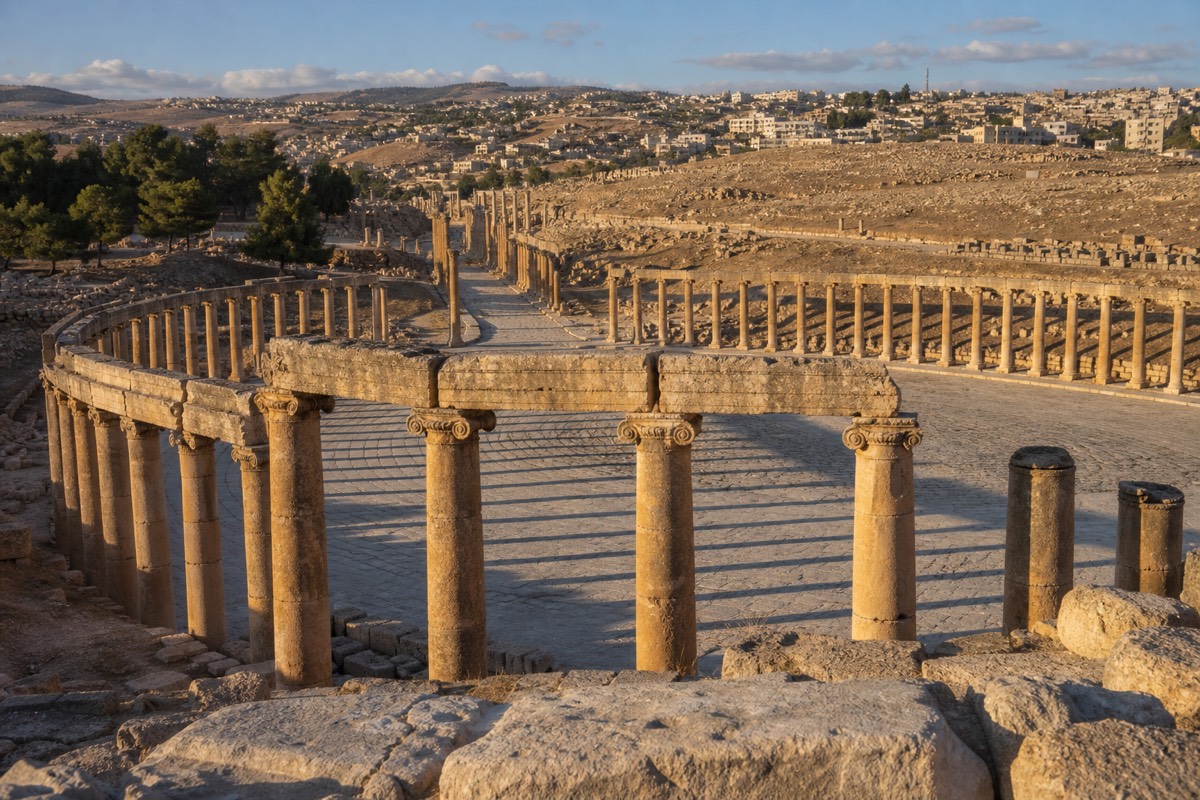
Jerash gets called "the Pompeii of the East" often enough that it has become a cliche, but stand in the Oval Plaza at opening time, before the tour buses arrive, and the comparison earns itself. Colonnades run in both directions further than you can easily photograph in one frame. The paving stones still carry the ruts worn by chariot wheels two millennia ago. This guide covers what you will actually walk through, what each structure was for, and the practical details of getting there from Amman.
What is Jerash, and why do people call it Jordan's best-preserved Roman city?
Jerash is the site of ancient Gerasa, a wealthy Roman provincial city in northern Jordan whose colonnaded streets, plazas, theatres and temples survive largely intact, buried and protected by earthquake debris and sand for centuries before excavation began. It is widely considered the best-preserved Greco-Roman provincial city outside Italy.
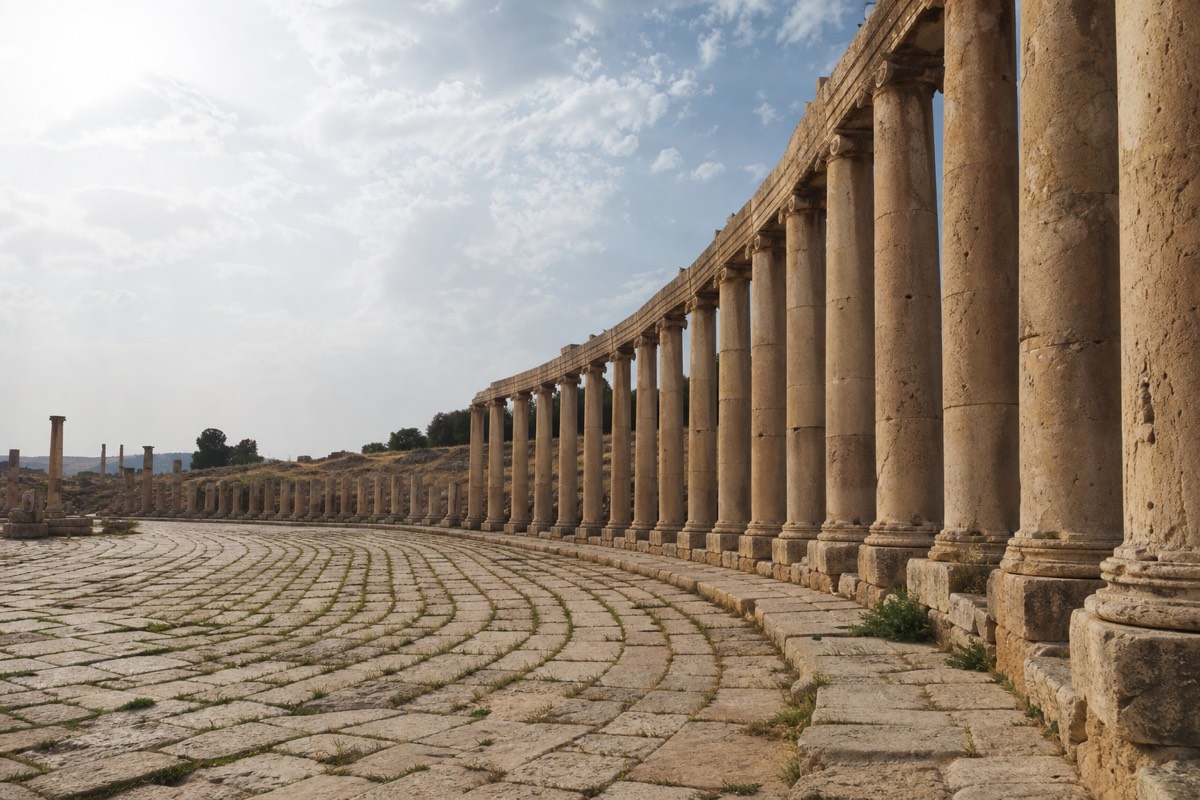
What sets Jerash apart from most Roman sites is completeness rather than any single spectacular structure. You get an entire functioning street grid: a forum, a main colonnaded avenue, two theatres, temples to two different gods, a hippodrome and city gates, all readable as one connected urban plan rather than isolated ruins scattered across a modern town. The site sits on Jordan's own UNESCO World Heritage Tentative List, submitted in 2004, though it has not yet been formally inscribed as a World Heritage Site.
How old is Jerash, and who built it?
The region around Jerash has been inhabited for more than 6,500 years, but the city as it stands today took shape as a Hellenistic settlement in the 2nd century BC, local tradition credits Alexander the Great or one of his generals with founding it, before it prospered under Roman rule and joined the Decapolis, a league of ten Greco-Roman cities across the region.
Jerash's wealthiest period ran through the first three centuries AD, funded by trade routes connecting it to Petra, Damascus and the Mediterranean coast. Emperor Hadrian visited in 129 AD, an event significant enough that the city built a triumphal arch to commemorate it, still standing today near the current entrance. A major earthquake in 749 AD did much of the damage that eventually buried large sections of the city under sand and rubble, which paradoxically helped preserve what excavators found starting in the early 20th century.
What will you actually see walking through Jerash?
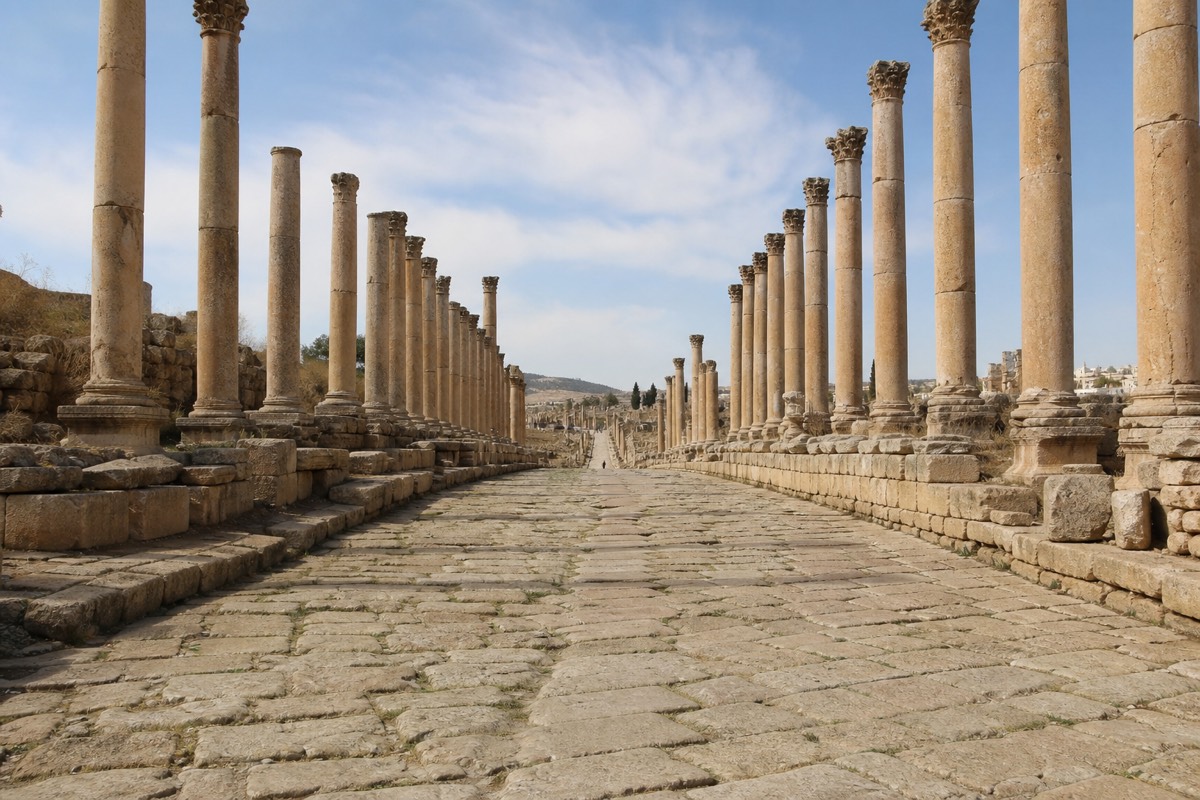
A typical visit moves through Hadrian's Arch, the Hippodrome, the South Gate, the Oval Plaza, the Cardo Maximus (the main colonnaded street), the Temple of Zeus, the South Theatre, the Temple of Artemis and the Nymphaeum, roughly in that order from the modern entrance to the far end of the ancient city.
It is a genuinely long walk, closer to a small town than a single monument, so pacing matters more here than at most archaeological sites. Most visitors spend two to three hours covering the route below without rushing; history-focused visitors comfortably fill half a day.
| Stop | What it is |
|---|---|
| Hadrian's Arch | Triumphal arch built for Emperor Hadrian's visit in 129 AD |
| The Hippodrome | A 245 by 52 metre chariot-racing arena that once seated up to 15,000 |
| Oval Plaza | An unusually shaped colonnaded forum linking the entrance to the Cardo |
| Cardo Maximus | The city's main colonnaded street, over half a kilometre long |
| Temple of Zeus | Hilltop temple overlooking the Oval Plaza and South Theatre |
| South Theatre | A 3,000-seat Roman theatre, built 90 to 92 AD, still used for performances |
| Temple of Artemis | The city's grandest, unfinished temple to its patron goddess |
How does Jerash compare to Petra?
Jerash and Petra are two entirely different kinds of ruin. Petra is a rock-cut Nabataean city carved into cliff faces around a narrow canyon; Jerash is a free-standing Roman provincial city built up from ground level, closer in feel to a walkable ancient town than a single dramatic monument.
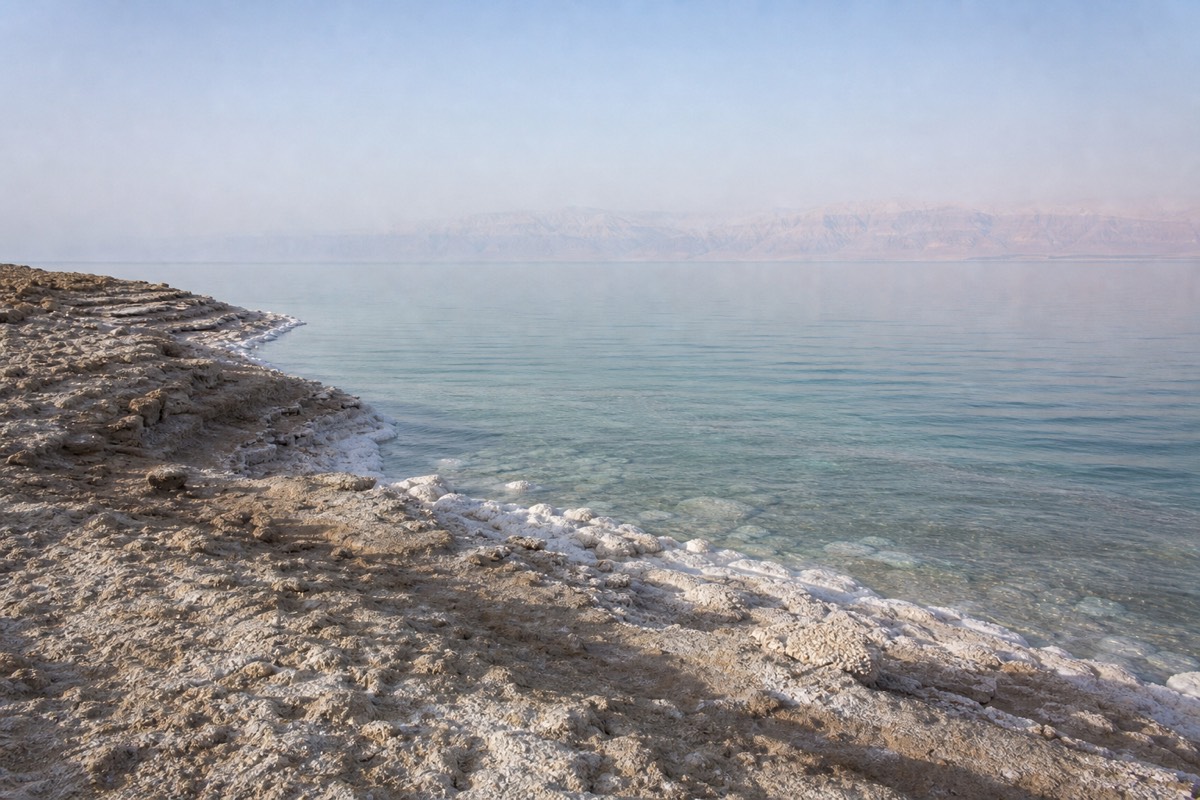
Neither replaces the other, and the operators we work with rarely hear anyone say they regretted seeing both. Petra wins on sheer visual drama, the Treasury reveal has no real equivalent anywhere else in Jordan, but Jerash wins on scale and completeness: you can trace an entire Roman city's street grid on foot in a way Petra's canyon geography does not allow. Petra also draws far larger crowds, since it is the singular reason most visitors come to Jordan at all, while Jerash, despite being more visited than most people expect, still feels comparatively uncrowded outside festival season.
| Jerash | Petra | |
|---|---|---|
| Built by | Greeks, then Romans | The Nabataeans |
| Construction style | Free-standing, built up from ground level | Carved directly into cliff faces |
| Distance from Amman | ~50 km north | ~240 km south |
| Entrance fee | ~12 JOD | ~50 JOD |
| Typical visit length | 2 to 3 hours | Half a day to a full day |
| Crowd level | Moderate | High, especially mid-morning |
What is the Oval Plaza, and why is its shape unusual?
The Oval Plaza is an asymmetrical, egg-shaped forum ringed by 56 Ionic columns, an unusual layout for a Roman city where forums are almost always rectangular. It was built to smooth the awkward angle between the North-South Cardo and the older road running toward the Temple of Zeus, and it now functions as the city's dramatic entrance space.
Archaeologists believe the plaza predates the Cardo Maximus that runs north from it, making it one of the earliest parts of the Roman-era layout. Standing at its centre with columns curving away on both sides is the closest Jerash gets to a single unmissable photograph, and it is worth the extra ten minutes to walk its full perimeter rather than cutting straight through toward the Cardo.
What is the Temple of Artemis, and why was it never finished?
The Temple of Artemis was Jerash's grandest religious structure, dedicated to the city's patron goddess and begun in the mid-2nd century AD, but construction stalled and only 12 of the planned 32 columns were ever completed. What remains is still striking: towering Corinthian columns, some of which visibly sway slightly in strong wind, a detail that unsettles first-time visitors who notice it.
The temple sat at the heart of civic and religious life in Roman Jerash, positioned on rising ground so its columns would have been visible across much of the city. Later occupants converted parts of the temple complex for other uses, including, in some periods, as a fortified position, which is part of why the site survived in recognisable form rather than being fully quarried for building material elsewhere.
What happens at the Hippodrome today?
The Hippodrome, a 245-metre chariot-racing arena that once held up to 15,000 spectators, now hosts the Roman Army and Chariot Experience, a live re-enactment show with actors playing legionaries, gladiators and chariot drivers, running most days except Tuesdays.
Wheel ruts from actual Roman-era chariot races are still visible in the arena floor beneath the sand, along with the remains of starting-gate altars, physical evidence that this was a working racing venue rather than a purely ceremonial space. The show itself runs a little over 30 minutes and is a paid add-on separate from the standard Jerash entrance ticket, with photo opportunities with the performers afterward.
| Roman Army and Chariot Experience | Detail |
|---|---|
| Venue | The Hippodrome |
| Schedule | Most days, typically twice daily, closed Tuesdays |
| Length | A little over 30 minutes |
| Cost | Separate ticket, not included in standard site entry |
How much does it cost to visit Jerash, and when is it open?
Standard entrance to Jerash runs around 12 Jordanian dinars per person, which includes access to the on-site archaeological museum, and Jerash is one of the 40-plus sites covered by the Jordan Pass. Opening hours shift seasonally, generally 8 AM to 6:30 PM in summer and 8 AM to 4 PM in winter.
If you are already planning to buy the Jordan Pass for Petra, Jerash effectively costs you nothing extra, since it is included in every tier. Ramadan hours run shorter, typically 8:30 AM to 6 PM, so check the current schedule against the site's official visitor information if your trip falls during that period.
| Period | Opening hours |
|---|---|
| Winter (Nov to Apr) | 8:00 AM to 4:00 PM |
| April to May | 8:00 AM to 5:30 PM |
| Summer | 8:00 AM to 6:30 PM |
| Ramadan | 8:30 AM to 6:00 PM |
| Entrance fee | Around 12 JOD per person, included with the Jordan Pass |
What is the best time of year to visit Jerash?
Spring (March to May) and early autumn (September to October) give the most comfortable walking conditions, mild temperatures and clearer light for photographs across the site's largely unshaded stretches. Summer is hot enough, often 30 to 35 degrees Celsius plus, that a morning visit is strongly preferable, and winter brings cooler days with a real chance of rain.
Because so much of Jerash, the Oval Plaza, the Cardo, the Hippodrome, sits fully exposed with no natural shade, the season affects comfort here even more than it does at Petra, where the Siq at least offers a shaded stretch. If your trip lands in July or August, an early-morning slot is worth prioritising over a leisurely afternoon visit.
| Season | Conditions |
|---|---|
| March to May | Mild, comfortable walking, occasional light rain early on |
| June to August | Hot, often 30 to 35°C+, little shade on site |
| September to October | Warm days, cooler evenings, generally dry |
| November to February | Cool, occasional rain, thinnest crowds |
How far is Jerash from Amman, and how do you get there?
Jerash sits about 50 kilometres north of Amman, and the drive takes roughly 40 minutes to an hour depending on traffic, making it a genuinely easy half-day or full-day trip from the capital rather than a major expedition.
Self-driving is straightforward on a well-marked highway. Public minibuses run from Amman's north bus terminal (Tabarbour) and are cheap, but they depart only once full, so waiting times can stretch past an hour on a quiet morning, which makes them a poor fit if you are trying to combine Jerash with anything else in the same day. Most visitors go by private car, a booked driver or a guided day tour, all of which remove that uncertainty entirely.
| From | Distance | Drive time |
|---|---|---|
| Amman (city centre) | ~50 km | ~40 to 60 minutes |
| Queen Alia International Airport | ~90 km | ~75 to 90 minutes |
Is Jerash worth combining with a Petra trip?
Yes, if your schedule allows more than a single Petra day. Jerash sits in the opposite direction from Petra relative to Amman, roughly 50 kilometres north versus roughly 240 kilometres south, so combining both in one long day is not realistic, but a multi-day itinerary that opens in Amman with Jerash before heading south fits naturally.
That is exactly the shape of our 4-day Jerash, Petra, Wadi Rum and Dead Sea tour, which spends its first day on Amman's Roman Theatre and Citadel plus Jerash before continuing south toward the Treasury and the Siq walk, a Wadi Rum jeep tour and a stop at the Dead Sea. If you are only in Jordan for two or three days, Jerash is usually the first thing to get cut, and that is a reasonable trade-off given Petra's pull, but it is worth knowing what you would be skipping.
What is the Jerash Festival, and when does it happen?
The Jerash Festival is an annual summer arts and culture festival held partly within the ruins themselves, using the South Theatre and, more recently, a new stage built in the Hippodrome for concerts, folk performances and theatre. The 2026 edition marked the festival's 40th year, with 213 scheduled events.
Watching a live performance in a 1,900-year-old Roman theatre is a genuinely different experience from walking the site in daylight, and it is worth checking the festival calendar if your trip overlaps with it. Outside festival dates, the South Theatre is still open to visitors and its acoustics are strong enough that a guide standing at the centre of the stage floor can be heard clearly from the topmost row without amplification, a demonstration most tour groups get to see firsthand.
What else can you pair with a Jerash day trip?
Ajloun Castle, an Ayyubid-era fortress built between 1184 and 1188 under a nephew of Saladin, sits roughly 30 kilometres and a 40-minute drive from Jerash through olive groves and hill country, making it a natural add-on if you have a full day rather than a half day free.
The castle was built to guard the region against Crusader raids and later served as an administrative centre under Ayyubid and Mamluk rule, and its hilltop position gives sweeping views over the Jordan Valley on a clear day. It is a quieter, less-visited stop than Jerash itself, which makes the pairing feel like a genuine two-site day rather than a rushed detour bolted onto the ruins.
How much time should you budget, and what should you bring?
Budget two to three hours for a focused walk through the main route, or half a day if you want to linger at the theatres and the Temple of Artemis and visit the small museum. Comfortable walking shoes matter here as much as at Petra, since the paving stones and column bases are uneven underfoot across most of the site.
Bring water, sunscreen and a hat, since large stretches of the site, particularly the Oval Plaza and the Cardo, offer no shade at all. A modest amount of cash in Jordanian dinars covers the museum donation box, snacks at the entrance cafes, and the Roman Army and Chariot Experience ticket if you decide to add it.
| Bring | Why |
|---|---|
| Comfortable walking shoes | Ancient paving stones and column bases are uneven throughout |
| Water and sunscreen | Long shadeless stretches through the plaza and the Cardo |
| A hat | Little shelter from midday sun across most of the site |
| Small JOD cash | Museum entry, cafes, and the optional chariot show |
So how should you plan a Jerash visit?
Go early if you can, walk the full route from Hadrian's Arch through to the Temple of Artemis rather than doubling back partway, and treat the Roman Army and Chariot Experience as a genuine option rather than a tourist trap, since the arena it runs in is the real thing. Jerash rewards a trip built around Amman rather than a rushed add-on to a Petra day, and pairing the two properly usually means giving Jordan more than one day. The easiest way to fit both into a single trip without spending your holiday negotiating drivers and entrance tickets is to let a guided itinerary handle it, and Petra Jordan Tours lines up the operators who run the Amman-Jerash-Petra route end to end, so the ruins are what you remember instead of the logistics.