
The Treasury (Al-Khazneh): Petra's Icon, and the Siq Walk to Reach It
Every photograph of Petra you have ever seen starts the same way: a sliver of blue sky, pink rock pressing in from both sides, then the canyon opens and a two-story facade appears, carved straight into the cliff. That first glimpse of the Treasury is the reason most people book a trip to Jordan at all. This guide covers the walk that gets you there, what Al-Khazneh actually is, and what is worth seeing once you have caught your breath.
Booking Choice: Private Petra Main Trail takes 2–3 hours, starting in Petra / Wadi Musa. Explore This Option
General starting recommendation. Petra admission, hotel drop-off and Monastery hike excluded. About 6 km of walking; moderate fitness.
We may earn a commission when you book through these links.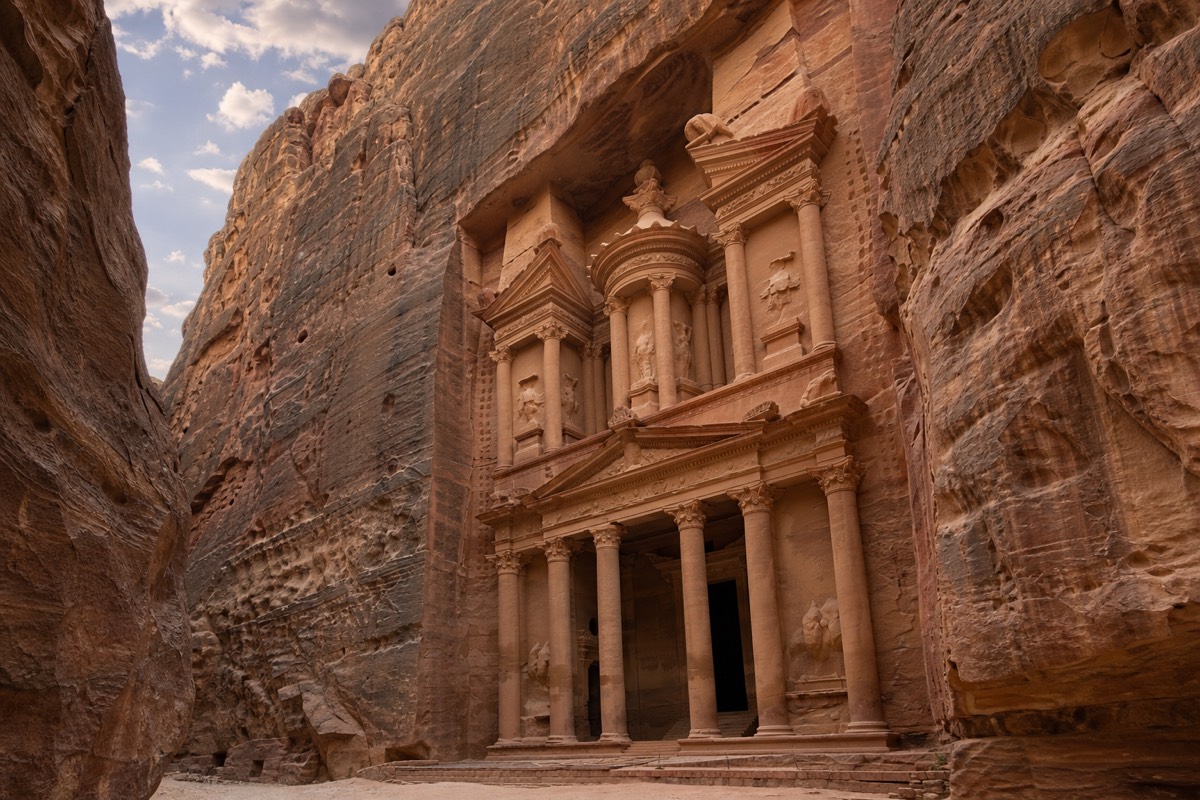
The Treasury does not appear gradually. You walk in shade for the better part of a mile, the canyon narrowing and twisting so you cannot see more than a few dozen metres ahead, and then a thin vertical crack of gold light opens between the rock walls and the facade is simply there, all at once, three stories of carved sandstone glowing rose and orange depending on the hour. Below is the walk that gets you to that moment, what the building actually is once you are standing in front of it, and what deserves your time on either side of it.
The Siq and the Treasury, by the numbers
Length and wall height of the Siq canyon, and the Treasury's own carved height, drawn from Petra's official visitor information (visitpetra.jo). Treat the walk distance as approximate and pace yourself for the return climb.
What is the Treasury (Al-Khazneh)?
Al-Khazneh, universally known as the Treasury, is a 39.5-metre-tall tomb facade carved directly into a sandstone cliff at the end of Petra's main canyon entrance. Despite the name, it never held treasure; it was built as a royal mausoleum during the reign of the Nabataean king Aretas IV, who ruled from roughly 9 BC to 40 AD.
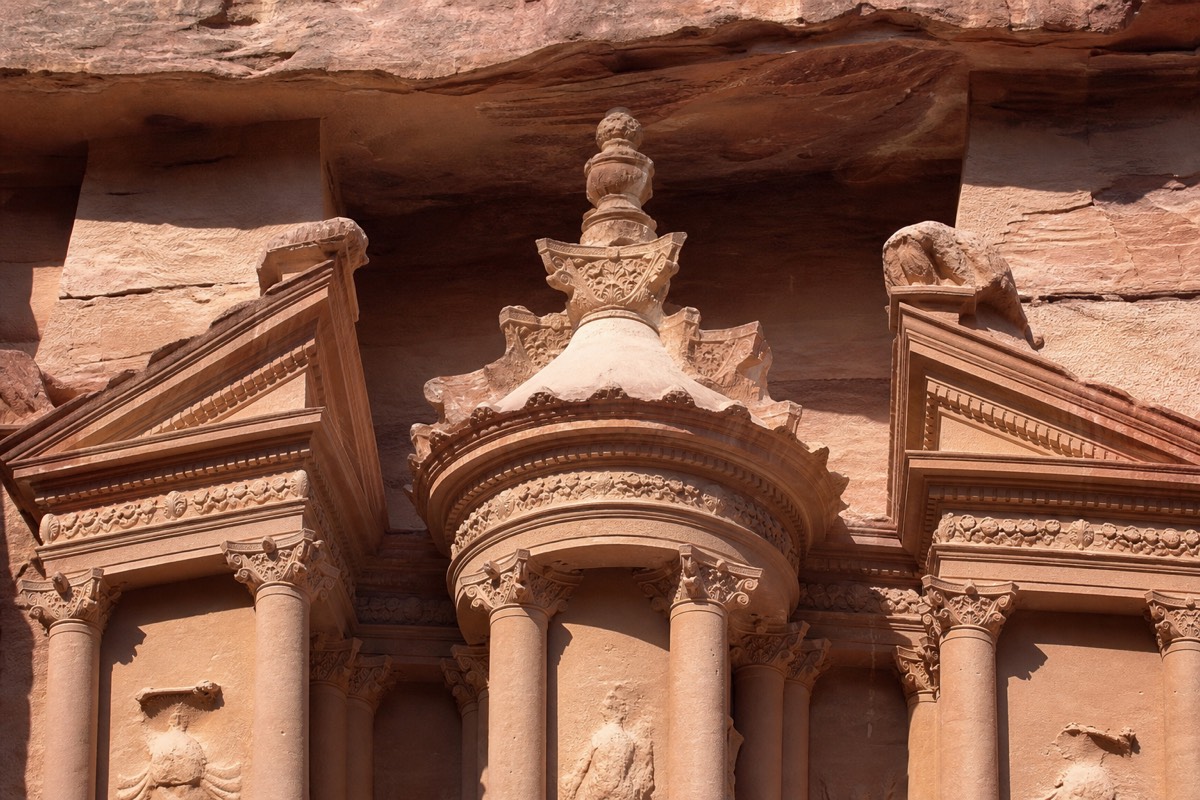
According to Petra's own tourism authority, excavations beneath the facade in 2003 uncovered three Nabataean royal tombs dating to the end of the first century BC, which is the strongest physical evidence that Al-Khazneh was built as a funerary monument for the Nabataean elite rather than a functional treasury of any kind. The facade itself is about 25 metres wide and carved in a Hellenistic style, with columns, a broken pediment and a central urn that later gave the building its popular name. It is Petra's single most recognisable structure and, for most visitors, the whole reason for the Jordan Pass and the trip itself.
How do you actually reach the Treasury?
You reach the Treasury on foot through the Siq, a narrow natural gorge that is the site's main entrance, starting from the Petra Visitor Center. There is no vehicle access and no shortcut: everyone, from first-time visitors to the tour groups that arrive later in the morning, walks the same canyon floor to get their first look.
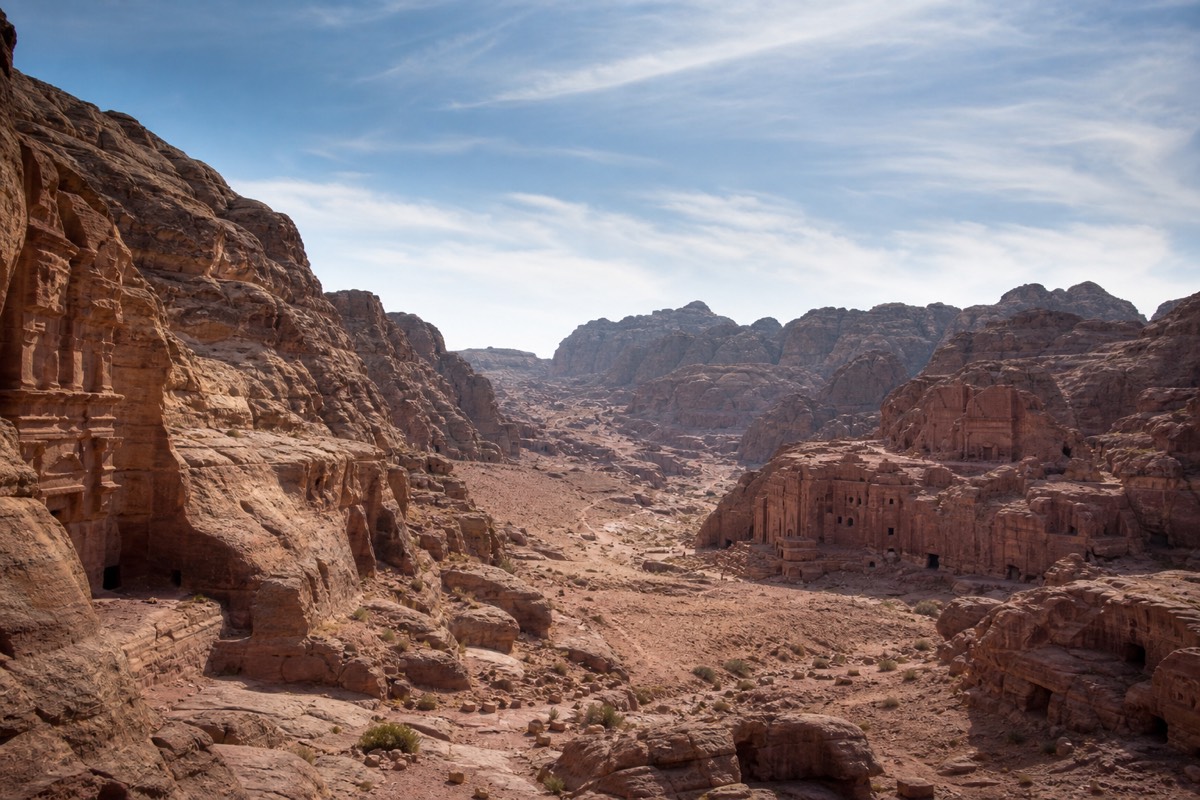
The approach begins well before the Siq itself. From the visitor centre you pass a scatter of free-standing tomb facades known as the Djinn Blocks and the Obelisk Tomb, a squarish monument topped with four pyramid-shaped obelisks, before the path narrows and the canyon walls begin to close in. That entrance stretch is roughly ten to fifteen minutes on its own, flat and easy, and it is a useful warm-up before the Siq's cooler, narrower confines. A horse ride from the visitor centre to the Siq entrance is traditionally included in the standard entrance ticket if you want to save your legs for later in the day.
How big is the Siq, and what should you notice on the way in?
The Siq is about 1.2 kilometres long, with walls that rise as high as 80 metres in places and narrow to as little as 3 metres across at the tightest points. It typically takes 25 to 35 minutes to walk at a relaxed pace, longer if you stop to look at the carved water channels along the walls.
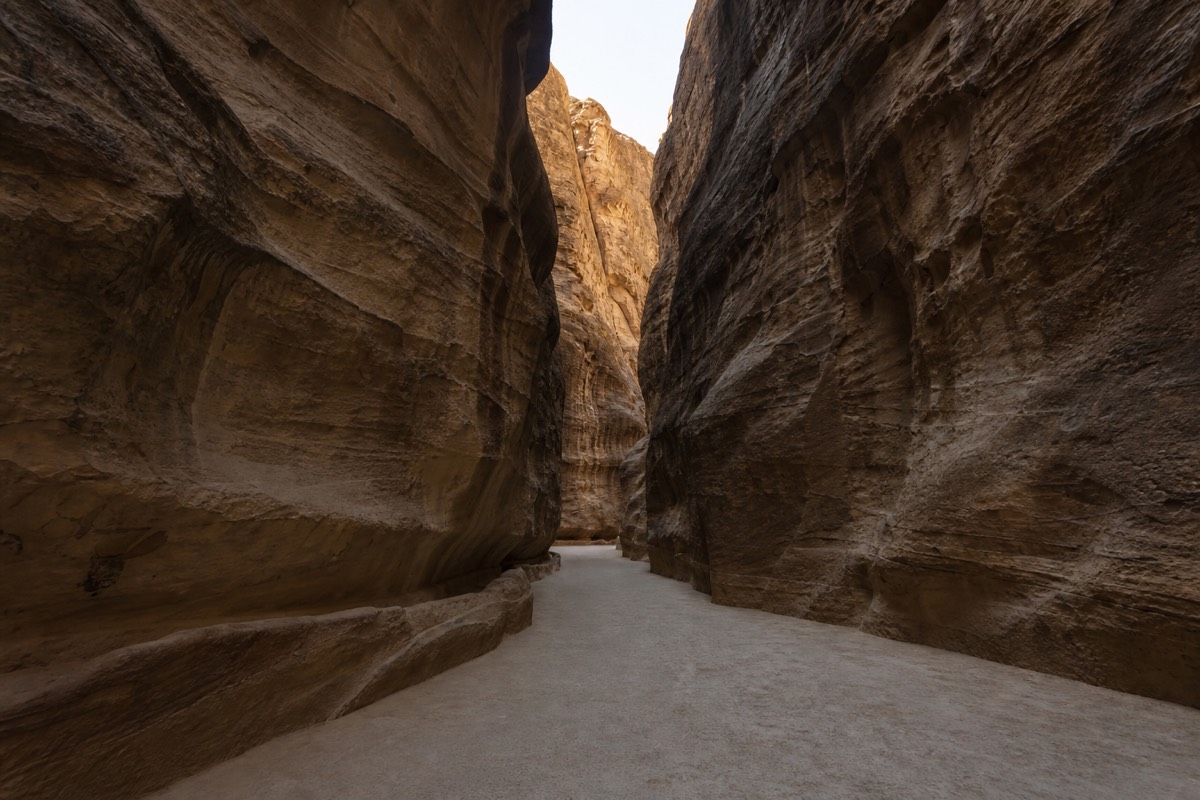
Those channels are not decoration. The Nabataeans cut a covered channel along one side of the canyon and laid ceramic pipes along the other to carry water from a spring roughly seven kilometres away into the city, part of a wider system of dams, cisterns and flood-control tunnels that let a desert trading capital support tens of thousands of people. National Geographic's account of Petra's engineering calls it one of the more sophisticated ancient hydraulic systems anywhere in the Middle East, and once you know to look for it, the grooves and niches carved into the rock walls stop looking random and start looking like plumbing. Early morning is the easiest time to actually stop and study them, before the canyon fills with the day's foot traffic.
| Measure | The Siq |
|---|---|
| Length | About 1.2 km, one way |
| Wall height | Up to about 80 m |
| Narrowest width | As little as 3 m in places |
| Walking time | 25 to 35 minutes at an easy pace |
| Surface | Packed dirt and stone, uneven in sections |
| Notable feature | Carved Nabataean water channels along both walls |
How old is the Treasury, and who built it?
The Treasury dates to the second half of King Aretas IV's reign, most likely sometime in the first half of the first century AD, making it roughly two thousand years old. It was carved by the Nabataeans, an Arab trading people who controlled the caravan routes through southern Jordan and built Petra as their capital.
What looks like a single carved building is really a facade cut into living rock, with almost nothing built up from the ground: the columns, pediment, urn and inner chamber are all subtracted from the cliff face rather than constructed. That is true of most of Petra's grand monuments, which is part of why they have survived two thousand years of desert weather: there is no mortar to fail and no foundation to settle, just sandstone that erodes slowly and, in occasional flash floods, catastrophically.
| Al-Khazneh (the Treasury) | Detail |
|---|---|
| Height | About 39.5 m |
| Facade width | About 25 m |
| Built | Reign of King Aretas IV, roughly 9 BC to 40 AD |
| Builders | The Nabataeans |
| Function | A royal tomb, not a treasury |
| Material | Carved directly into sandstone bedrock |
Is the treasure inside the urn real?
No. The name comes from a Bedouin legend that an Egyptian pharaoh hid gold inside the stone urn carved above the entrance, and for generations local tribesmen fired rifles at it hoping to break it open. You can still see the bullet scars on the urn today, but the urn is solid sandstone; it was never hollow and never held anything.
The legend is old enough and persistent enough that it gave the building its name in both Arabic (Al-Khazneh, "the treasury") and English, long before archaeologists established what the structure actually was. It is a good reminder that a lot of what tourists hear on-site is folklore rather than fact, which is part of why a guide who can separate the two is worth having when you visit.
What was actually found inside the Treasury?
The Treasury's main chamber is a plain, largely empty room, but excavations beneath and around the structure have found real burial chambers and human remains, which is a genuinely different question from the urn legend above. We cover what was found, and what it means, separately.
If you want the full, sourced answer rather than a rumour repeated on a walking tour, see our piece on what was actually found inside the Treasury. The short version worth knowing before you go: the interior itself is not the dramatic part. It is a bare, high-ceilinged room. The archaeology that matters is underground, in the tombs cut beneath the facade, most of which stayed sealed and unnoticed for centuries.
What comes after the Treasury? The Street of Facades and the Royal Tombs
Past the Treasury, the canyon widens into the Outer Siq, lined with dozens of smaller tomb facades known as the Street of Facades, before opening onto the main city area where the Royal Tombs rise along the eastern cliff face: the Urn Tomb, Silk Tomb, Corinthian Tomb and Palace Tomb.
These four are the grandest tombs in Petra after the Treasury itself, and they are far less crowded, since most tour groups linger at the Treasury and move on to the Roman Theatre and Colonnaded Street without walking the short climb up to this row. The Urn Tomb has a broad forecourt with sweeping valley views and is thought to belong to the Nabataean king Malchus II. The Silk Tomb is named for the swirling pink, white and yellow bands of rock across its face, entirely natural, not painted. The Corinthian Tomb borrows its layout directly from the Treasury. The Palace Tomb is the widest facade in Petra, modelled loosely on a Roman palace front.
| Tomb | What makes it worth the stop |
|---|---|
| Urn Tomb | Broad forecourt, likely built for King Malchus II, wide valley views |
| Silk Tomb | Natural swirling rock colour across the whole facade |
| Corinthian Tomb | Echoes the Treasury's design, quieter to photograph |
| Palace Tomb | Petra's widest carved facade, three visible storeys |
What does the walk look like, checkpoint by checkpoint?
From the Visitor Center to the Treasury is a walk of roughly 800 metres to a kilometre before the Siq even starts, followed by the 1.2-kilometre Siq itself, then another short stretch past the Treasury to reach the Royal Tombs, all told a route of around 3 kilometres round trip if you stop at the tombs and turn back.
Most people underestimate how much of the walk happens before the famous part. The Djinn Blocks and Obelisk Tomb sit in open desert light, then the Siq's shade is a genuine relief, then the Treasury reveal happens fast, in the space of a few steps. Budget the full stretch as one continuous walk rather than a quick in-and-out: the Royal Tombs alone are worth another twenty to thirty minutes if you climb up to the Urn Tomb's terrace.
| Checkpoint | Distance from Visitor Center | What you'll see |
|---|---|---|
| Djinn Blocks & Obelisk Tomb | ~700 m | Free-standing early Nabataean monuments |
| Siq entrance | ~900 m | The canyon narrows and the water channels begin |
| The Treasury | ~2.1 km | The Siq opens and Al-Khazneh appears |
| Street of Facades | ~2.3 km | Dozens of smaller carved tombs |
| Royal Tombs | ~2.6 km | Urn, Silk, Corinthian and Palace Tombs |
When is the best time of day to walk the Siq to the Treasury?
Early morning, between 6 and 9 AM, is the best window: the light in the Siq is soft, the Treasury still sits in cool shade or catches the first direct sun, and the canyon is close to empty. Coach groups typically arrive from about 9:30 to 10 AM, and from then on the Treasury forecourt fills quickly.
The trade-off is straightforward. Go early and you get a nearly silent canyon and the best photographs, but you are walking before you have fully woken up and before the site's cafes are properly open. Go mid-morning or later and you get a livelier atmosphere, more camel and horse-cart operators offering rides, and a Treasury forecourt that can feel more like a plaza than a discovery. If your schedule allows it, a return visit to the Treasury in the late afternoon, after the day-trip crowds have thinned out and moved deeper into the site, is an underrated second option. That is the daily rhythm; the wider calendar matters too, and our breakdown of the best month to visit Petra covers how the same early-morning window shifts with the seasons.
| Time | Crowd level | Light |
|---|---|---|
| 6 to 9 AM | Lightest of the day | Soft, the Treasury often still shaded |
| 9:30 AM to noon | Busiest, coach groups arrive | Bright, high contrast |
| Midday to 3 PM | Busy, hottest part of the day | Harsh overhead sun |
| Late afternoon | Thinning out | Warm, golden light returns |
Should you add the Monastery while you are there?
If you have the time and the legs for it, yes. The Monastery, or Ad-Deir, is a second and even larger facade reached by a separate climb of roughly 800 to 850 stone steps beyond the Royal Tombs, and it rewards the effort with a facade even bigger than the Treasury and none of the same crowds.
It is a genuinely different undertaking from the Siq walk, closer to an hour of steady climbing than a stroll, so treat it as a decision rather than an afterthought. We cover the climb itself, what to expect on the steps, and whether it is worth it for your fitness level and time budget in a dedicated guide to the Monastery's 800-step climb.
How much walking is really involved?
Treasury and Royal Tombs only is a manageable 3 to 4 kilometres round trip on mostly flat or gently sloping ground, well within reach of most fitness levels. Add the Monastery climb and you are looking at closer to 8 to 10 kilometres total with a genuine uphill stretch, which is a different kind of day.
Petra covers more than 100 square kilometres in total, and the walk described in this guide covers only a small slice of it, the part almost every visitor does regardless of how many days they have. A single guided day trip typically gives you around five hours on site once the drive from Amman is accounted for, which is comfortable for the Treasury, Street of Facades and Royal Tombs, tight if you also want the Monastery. If you are weighing a longer stay against a single day, our guide to how many days you actually need at Petra breaks the trade-offs down properly, and our take on whether Petra is worth visiting is worth a read if you are still deciding at all.
| Route | Approx. distance | Terrain | Time needed |
|---|---|---|---|
| Treasury only, there and back | ~4.2 km | Flat, packed dirt | 1.5 to 2 hours |
| + Street of Facades & Royal Tombs | ~5.2 km | Flat with a short climb to the tombs | 2.5 to 3 hours |
| + Monastery (Ad-Deir) | ~8 to 10 km | Adds 800+ steps, steady uphill | 4.5 to 6 hours |
What should you bring for the walk?
Comfortable, broken-in walking shoes, 1.5 to 2 litres of water per person, high-SPF sunscreen, a hat and sunglasses cover the essentials. The canyon floor is uneven stone and packed dirt in places, and there is little shade once you are past the Siq, so sun protection matters even on a walk that looks short on a map.
A light scarf or buff is useful against dust on a windy day, and a light jacket earns its place if you are walking before sunrise, since the Siq holds the night's cool air well into the morning. Keep a little cash in small Jordanian dinar notes for tips or a camel ride back from the Royal Tombs to the Visitor Center, since that stretch is longer than most first-timers expect on the way out.
| Item | Why it matters |
|---|---|
| Broken-in walking shoes | Uneven stone and dirt underfoot for most of the route |
| 1.5 to 2 L water per person | Little shade beyond the Siq, even in cooler months |
| Sunscreen, hat, sunglasses | Reflected desert sun is stronger than it looks |
| Small JOD cash | Tips, camel or cart rides, small snacks on site |
| Light jacket (early starts) | The Siq stays cool well after sunrise |
So how should you plan your Treasury visit?
Walk in early if you can manage it, give the Royal Tombs the same attention most people only give the Treasury, and decide on the Monastery before you set off rather than partway up the steps. Whether you have three hours or three days, the Siq and the Treasury are the fixed point everyone's Petra trip is built around, and getting the timing right changes the whole visit more than almost anything else on this list. The simplest way to handle the logistics, the transport from Amman and the entrance arrangements is to let a guided trip carry the planning, and Petra Jordan Tours lines up the operators who run these routes, so the part you remember is the moment the canyon opens, not the admin that got you there.