
The Monastery (Ad-Deir): Petra's 800-Step Climb, Is It Worth It?
The Treasury gets the photo everyone recognizes. The Monastery gets the argument: is an 800-step climb, in desert heat, worth it for a facade you've probably never seen a picture of? It is bigger than the Treasury, older than its Christian-era name suggests, and reached by a genuinely demanding staircase that filters out a large share of Petra's day visitors before they ever see it. Here is exactly how long the climb is, what you'll actually pass on the way up, and whether it earns the effort.
Booking Choice: Petra Back Entrance And Monastery takes 5–7 hours, starting in Petra / Wadi Musa. Explore This Option
General starting recommendation. Still involves steps and substantial walking. Admission and hotel drop-off excluded; return walk from Treasury independent.
We may earn a commission when you book through these links.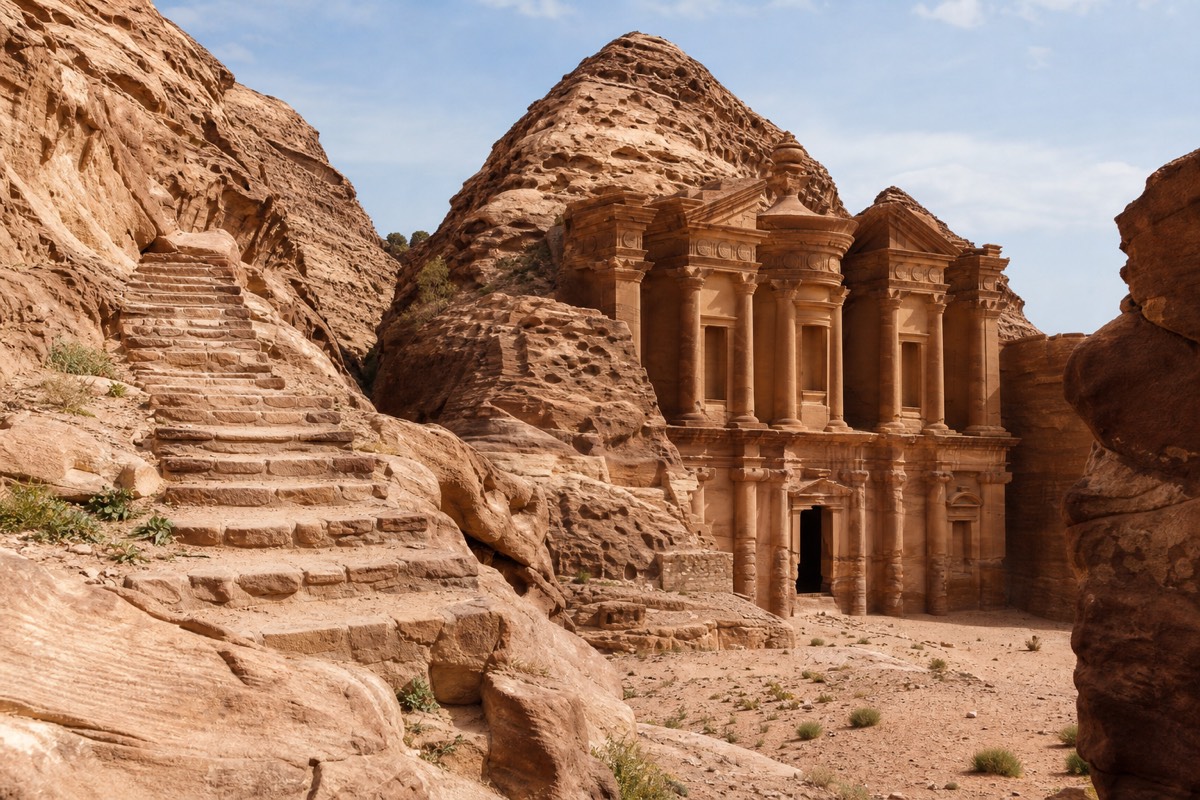
Every day, thousands of people walk into Petra, see the Treasury, and turn back before ever reaching the second monument that actually outsizes it. The Monastery sits at the top of a climb steep enough to genuinely thin out the crowd, which is exactly why the people who make it up tend to describe it as the better payoff of the two. Here is the real climb, the real history, and an honest answer on whether it is worth your legs.
The Monastery climb, by the numbers
Distance, steps, elevation gain and typical climb times for the Ad-Deir trail, drawn from the figures already verified and published on this site's own Petra pages.
What is the Monastery, and why do people climb 800 steps to see it?
The Monastery, known locally as Ad-Deir, is a monumental facade carved directly into the sandstone cliff at the far end of Petra, larger than the famous Treasury, reached only by a steep staircase since no road or vehicle track leads up to it, which is exactly what keeps it quieter than the sites near the entrance.
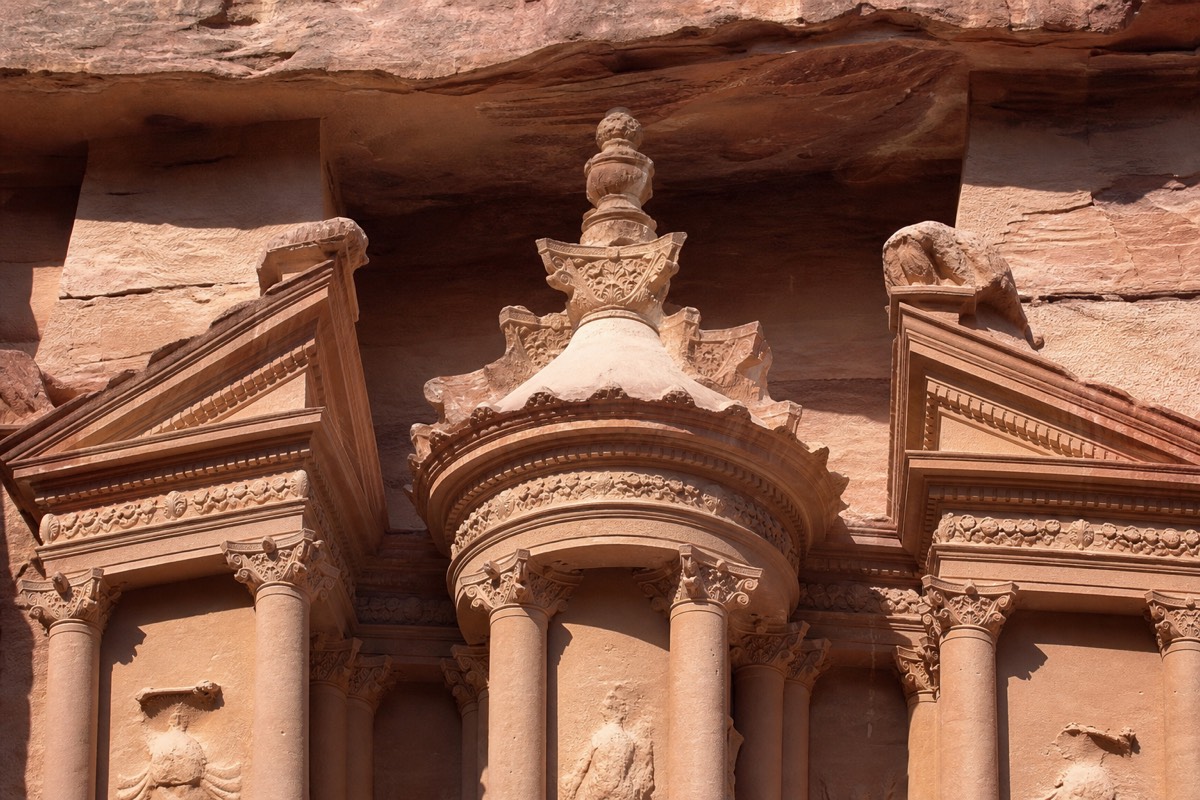
Unlike the Treasury, which greets you almost immediately after the Siq, the Monastery sits well past the site's central cluster of tombs and the Roman Theatre, at the top of a climb that takes real effort. That single fact, that you have to work for it, is most of why it feels different to stand in front of: fewer tour groups, more space to actually look at the carving, and a genuine sense of having earned the view.
How big is the Monastery, really?
The Monastery's facade measures roughly 47 meters wide by 51 meters high according to the official Petra Development and Tourism Region Authority, noticeably larger than the Treasury's approximately 25 meters wide by 39 meters high, which makes Ad-Deir the single largest monument carved into Petra's rock.
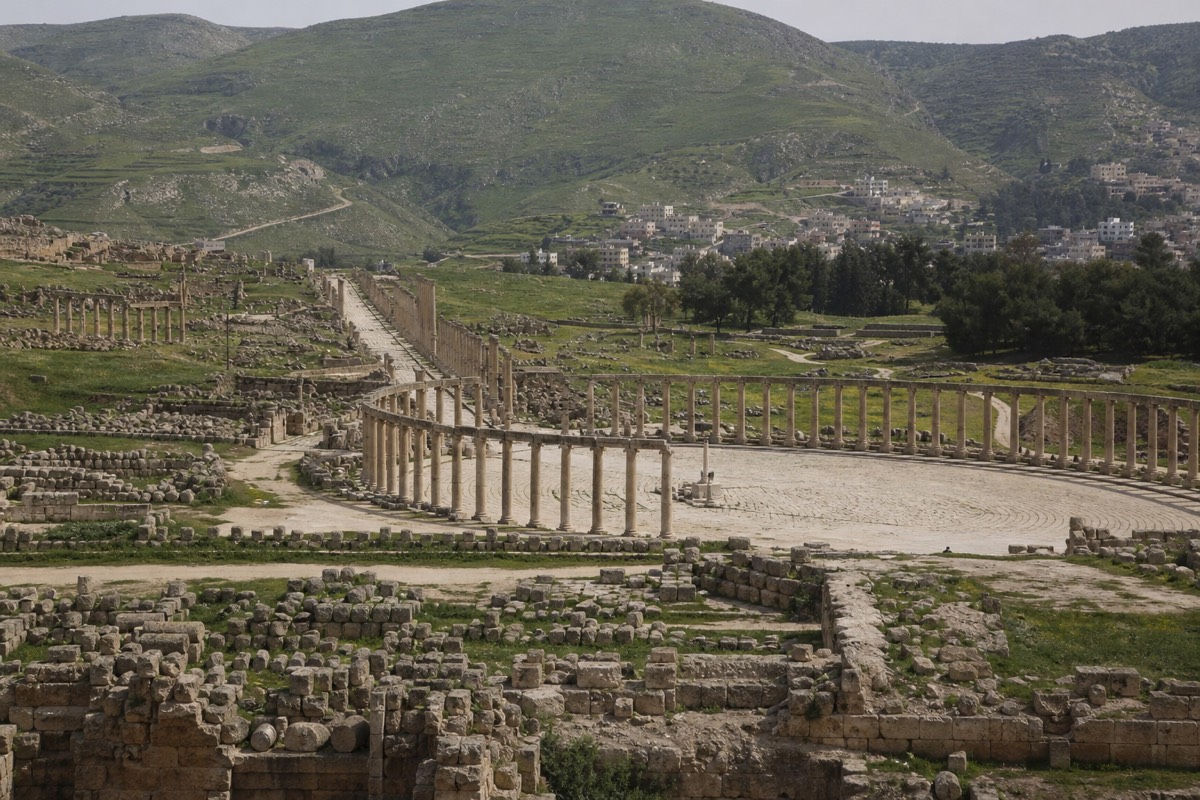
Numbers alone undersell the scale. A facade over 50 meters tall is roughly the height of a 15-story building, carved by hand directly into a cliff face with no scaffolding beyond what the Nabataeans built themselves. Standing at its base, especially without a crowd blocking the view, is the moment most visitors say finally makes the climb feel worth it, regardless of how their legs feel.
| Measure | The Treasury | The Monastery |
|---|---|---|
| Facade width | ~25 m | ~47 m |
| Facade height | ~39 m | ~51 m |
| Distance from the Siq | Immediate | A separate uphill trail |
| Typical crowd level | Highest in Petra | Noticeably quieter |
How did Ad-Deir get its name?
Ad-Deir means "the Monastery" in Arabic, a name it earned centuries after it was carved, when Byzantine Christians used the chamber as a chapel and carved crosses into the back wall; per the official Petra site authority, its actual construction likely dates to the early 2nd century AD under the Nabataean king Rabel II, originally as a ceremonial hall, not a religious building in the Christian sense at all.
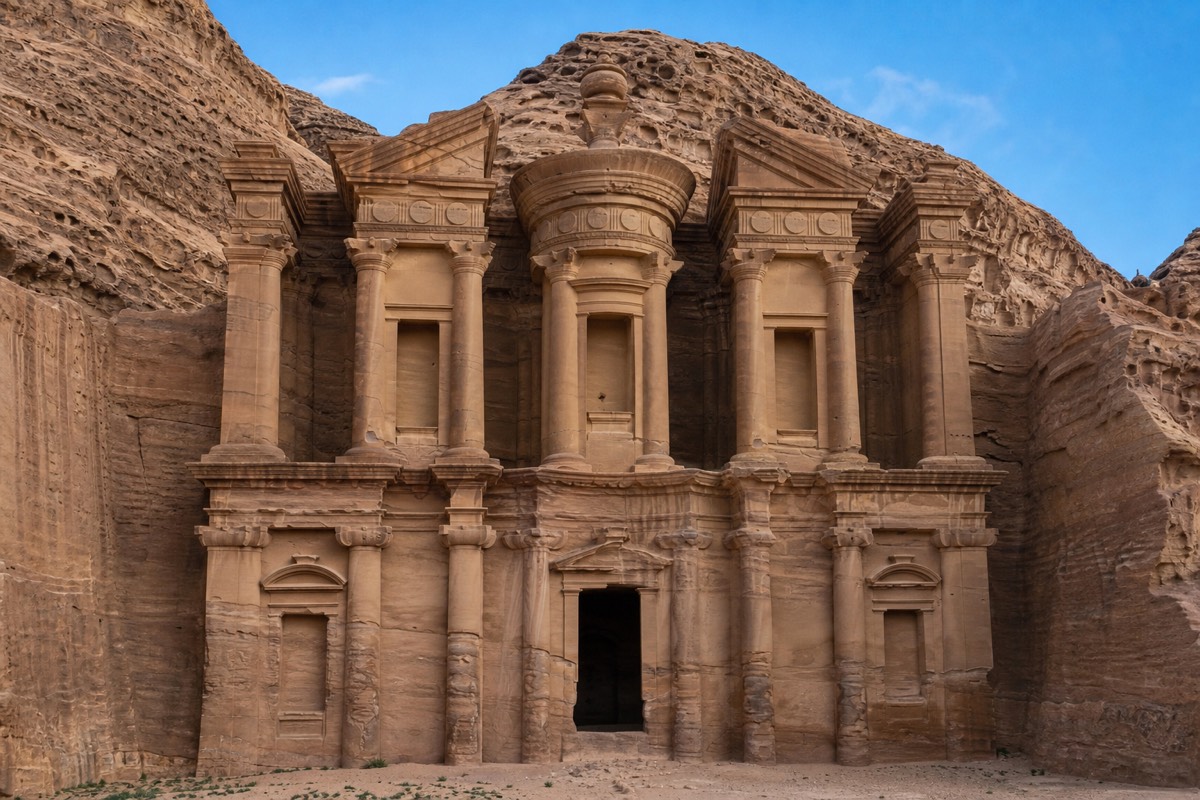
That means the name is a kind of historical accident. The building's original purpose, per the Petra Development and Tourism Region Authority, was as a biclinium, a large hall used by religious associations for ceremonial gatherings, complete with stone benches along the walls and an altar-like feature at the back. It was only centuries later, once Byzantine Christians in the region repurposed the space and carved crosses into that same back wall, that it picked up the name people still use today. Wikipedia's entry on the site covers this layered history in more detail for anyone who wants the fuller archaeological picture.
How long is the hike, exactly?
The trail to the Monastery runs about 1.2 kilometers one way, climbing roughly 800 to 850 stone steps for an elevation gain of about 200 to 250 meters, which most visitors cover in 30 to 45 minutes on the way up and a faster 20 to 30 minutes coming back down.
Those numbers, drawn from the same figures published across this site's own Petra guides, are worth taking seriously before you commit to the climb rather than discovering them halfway up. It is not a flat walk with the occasional step, it is a sustained staircase for the better part of a mile, and the elevation gain alone is comparable to climbing roughly 65 to 80 flights of stairs. The infographic above lays out all four figures together.
How hard is the climb, really, and who should think twice?
The climb is genuinely moderate to strenuous, not a casual stroll, and it is worth thinking twice about if you have significant knee or joint problems, limited mobility, or a serious heat sensitivity, since there is minimal shade for most of the ascent and the only way down is the same staircase you climbed up.
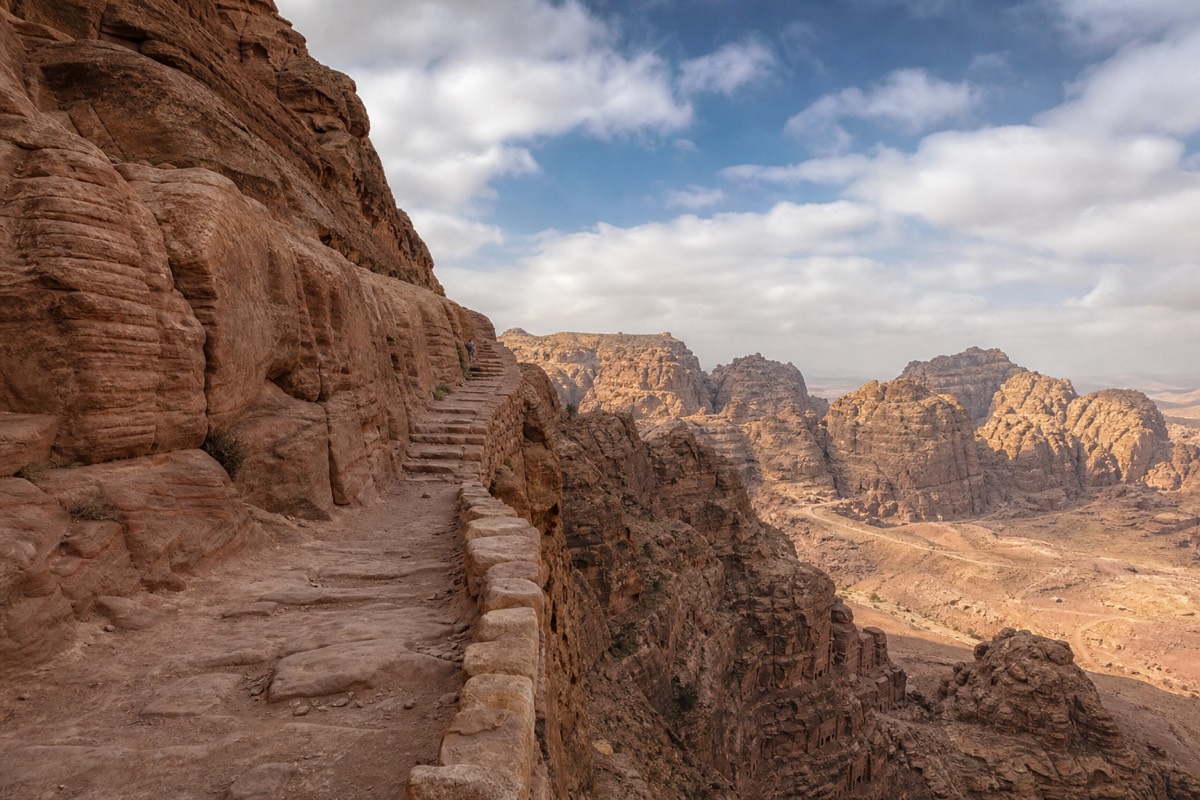
That said, "strenuous" here means sustained effort, not technical difficulty. There is no scrambling or exposure to worry about, the steps are uneven in height but the path itself is clear and well trodden, and reasonably fit adults of most ages complete it without special preparation. Donkeys are available for hire at the base for travelers who want the view without walking the whole staircase themselves, which is a legitimate option worth knowing about rather than a fallback to be embarrassed about.
The descent deserves its own word of caution, since most of the injuries people mention afterward happen going down, not up. Coming down is faster and easier on the lungs, but harder on the knees, and the uneven step heights that were a minor annoyance on the way up become a real trip hazard when you are tired and moving quickly. Slowing down on the way back is worth more than it sounds like it should be, and trekking poles, while not common gear for a desert trip, genuinely help anyone with knee sensitivity who plans to make the climb.
What does the trail actually look like, step by step?
The staircase winds up through a narrow gorge lined with smaller tomb facades and side chambers, passing the Lion Triclinium, a shrine named for the worn lion carvings flanking its entrance, and further up a detour to the Hermitage, a rock pinnacle with Byzantine-era crosses carved into its caves, before the path opens onto the plateau where the Monastery itself comes into view.
Along the way, small Bedouin-run stalls sell tea, water and souvenirs at a handful of rest points, which double as a legitimate excuse to catch your breath without feeling like you are stopping for weakness. The final stretch is the payoff: the staircase levels out, the gorge opens into a wide plateau, and the Monastery's facade appears all at once rather than gradually, which is part of why it lands as such a strong visual moment after the climb.
| Landmark | What it is | Roughly where |
|---|---|---|
| Lion Triclinium | A shrine with worn lion carvings at its entrance | A short detour early on the trail |
| Rest stops and tea stalls | Small Bedouin-run stands | Scattered along the staircase |
| The Hermitage | A rock pinnacle with Byzantine-era carved crosses | A side detour further up |
| The Monastery plateau | Where the facade comes fully into view | The top of the climb |
What time of day should you climb it?
Morning is the better window, ideally starting the climb by mid-morning at the latest, since the staircase has little shade and the desert heat builds fast after midday, and an early start also means reaching the plateau before the bulk of the day's foot traffic has made its way up.
Because the Monastery sits so far from the entrance, most visitors naturally tackle it later in their visit, after the Siq, the Treasury and the Street of Facades, which pushes a lot of people onto the staircase in the early-to-mid afternoon, exactly the wrong window for heat. If your schedule allows it, front-loading the walk to the Monastery earlier in the day and saving the closer, shadier sites for the afternoon is a genuinely useful way to reorder a Petra visit.
| Time | Heat | Crowd on the staircase |
|---|---|---|
| Early morning | Cool | Lightest |
| Late morning to midday | Building fast | Moderate |
| Early afternoon | Peak heat | Heaviest, most visitors climb here |
| Late afternoon | Cooling | Thinning out, light fading fast |
What can you actually see from the plateau at the top?
Beyond the facade itself, the plateau at the top of the climb opens onto genuinely wide desert views, and a short further scramble up a rock opposite the Monastery leads to a viewpoint that looks out toward the Wadi Araba valley, which on a clear day is one of the better panoramic views anywhere in Petra.
There are a couple of small tea stands at the top too, run by the same Bedouin families who operate the stalls along the staircase, and sitting with a hot mint tea looking out at the facade you just climbed for is, for a lot of visitors, the actual highlight rather than the climb itself. The area rarely feels crowded even at midday, since the staircase filters out enough of the crowd that the plateau never sees the density the Treasury does just after opening.
How does the Monastery trail compare to Petra's other hiking routes?
The Monastery trail is the single most popular hike in Petra because it leads to a major monument, while the High Place of Sacrifice trail, the site's other well-known climb with a broadly similar step count according to Rough Guides' route notes, leads to a ritual altar and viewpoint rather than a carved facade, and the two are rarely done back to back in one visit.
Both trails demand a genuine staircase climb and both reward the effort with a view and a monument you cannot see from the valley floor. The practical difference is what is waiting at the top: the Monastery gives you a second enormous facade to rival the Treasury, while the High Place of Sacrifice gives you a Nabataean ritual site and one of the widest panoramic views over central Petra. Travelers with two days often split them, one per day, rather than trying to fit both into a single visit.
| Trail | Roughly how long | What's at the top |
|---|---|---|
| Monastery (Ad-Deir) | ~1.2 km one way, 800-850 steps | A monumental facade larger than the Treasury |
| High Place of Sacrifice | Roughly 700-800 rock-cut steps | A Nabataean altar and a wide valley view |
Is the Monastery worth the climb, honestly?
For most travelers with reasonable fitness, yes, and by a fair margin: the combination of a genuinely larger monument, a noticeably thinner crowd, and the sense of having actually earned the view sets it apart from nearly everything else inside Petra that you can reach by simply walking a flat path.
The honest exception is a visitor with real mobility limits, a tight schedule that only allows an hour or two inside the site, or a hard aversion to sustained stair climbing in heat, for whom the donkey option or simply skipping it in favor of the closer monuments is a perfectly reasonable call. If you are weighing this against the rest of what Petra offers, our honest take on whether Petra as a whole is worth visiting covers the bigger picture.
How does the Monastery fit into a single Petra day, or do you need two?
Fitting the Monastery into a single-day Petra visit is realistic if you start early and pace the rest of the day around it, but it does mean the climb eats a meaningful chunk, roughly an hour round trip at minimum plus time at the top, out of whatever total hours you have on site.
This is exactly where trip length starts to matter. A visit with only a few hours on site may need to choose between the Monastery and a slower, fuller look at the closer monuments, while a longer stay removes that trade-off entirely. Our piece on how many days you actually need in Petra breaks down what different visit lengths realistically fit, and if you have not settled on an overnight base yet, our guide to staying in Wadi Musa covers how an early start changes what's possible in a single day.
Which of our tours actually make time for the Monastery climb?
Three of our four Petra-focused tours explicitly note the Monastery as an available climb within the visit, while the fourth's tighter Petra window means the climb is not built into the plan by default, so it is worth confirming directly with the operator if reaching the top is a priority for your trip.
The Petra Day Trip from Amman and the 3-Day Jordan Highlights Tour both flag the Monastery climb as a real option within their Petra time. The Private 3-Hour Guided Experience goes further, its guided walk actually ends close to the base of the Monastery steps, leaving you to self-explore the climb on your own schedule rather than as a rushed add-on. The 4-Day tour allocates a shorter, more tightly timed window at Petra as part of a fuller multi-stop itinerary, so travelers who specifically want the Monastery on that route should ask about it when booking rather than assuming it is automatically included.
| Tour | Monastery climb |
|---|---|
| Petra Day Trip from Amman | Noted as an available option within the visit |
| Petra Private 3-Hour Guided Experience | Walk ends near the base of the steps; self-guided climb from there |
| 3-Day Jordan Highlights Tour | Noted as an available option within the visit |
| 4-Day Jerash, Petra, Wadi Rum & Dead Sea Tour | Shorter Petra window; confirm with the operator if the climb is a priority |
What should you bring for the climb specifically?
Beyond the usual Petra day pack, the Monastery climb specifically calls for 1.5 to 2 liters of water carried with you rather than planned for later, broken-in walking shoes rather than sandals, small cash for the tea stalls or a donkey ride, and a genuine willingness to go slow, since there is no shame in resting on a staircase this long.
Sandals and new, unbroken-in shoes are the two most common regrets on this specific trail; the steps are uneven enough that ankle support and grip both matter more here than almost anywhere else in Petra. A change of shirt for the way back, packed in a small daypack, is a small addition that a surprising number of people wish they had brought, since the climb in desert heat is genuinely sweaty work even for fit travelers.
| Item | Why it matters on this climb |
|---|---|
| 1.5-2 liters of water | Minimal shade for most of the ascent |
| Broken-in walking shoes | Uneven stone steps for nearly the whole climb |
| Small JOD cash | Tea stalls and the donkey option don't take cards |
| Hat and sunscreen | Direct sun for most of the 1.2 km trail |
So, should you make the climb?
If your legs, your schedule and the weather all cooperate, the Monastery is one of the clearest cases in Petra where more effort genuinely buys a better experience, a bigger facade, a thinner crowd, and a real sense of arrival that the Treasury, mobbed within minutes of the Siq, cannot offer anymore. Plan the climb for the morning, carry more water than feels necessary, and give yourself the full round trip rather than rushing it. The easiest way to make sure the rest of your Petra day actually leaves room for it is to let a guided trip handle the pacing and the logistics, and Petra Jordan Tours lines up the operators who build that kind of time into their itineraries, so the climb is the part of the day you remember, not the rush to fit it in.