
Things to Do in Amman Before Your Petra Tour
Most Petra itineraries treat Amman as a layover, a place to sleep off jet lag before the real trip starts two and a half hours south. That undersells it. Amman is a genuinely interesting city in its own right, seven thousand years of continuous settlement stacked into one hillside skyline, and a single extra day here changes the shape of a Jordan trip more than people expect before the drive south to the Treasury and the Siq walk. Here is what is actually worth your time, where to base yourself, and the honest practical questions people ask before they book.
Booking Choice: Small-Group Amman Food Walk takes 3 hours, starting in Amman. Explore This Option
General starting recommendation. Meet by Rainbow Street entrance benches. Vegetarian options available; allergen cross-contamination cannot be ruled out.
We may earn a commission when you book through these links.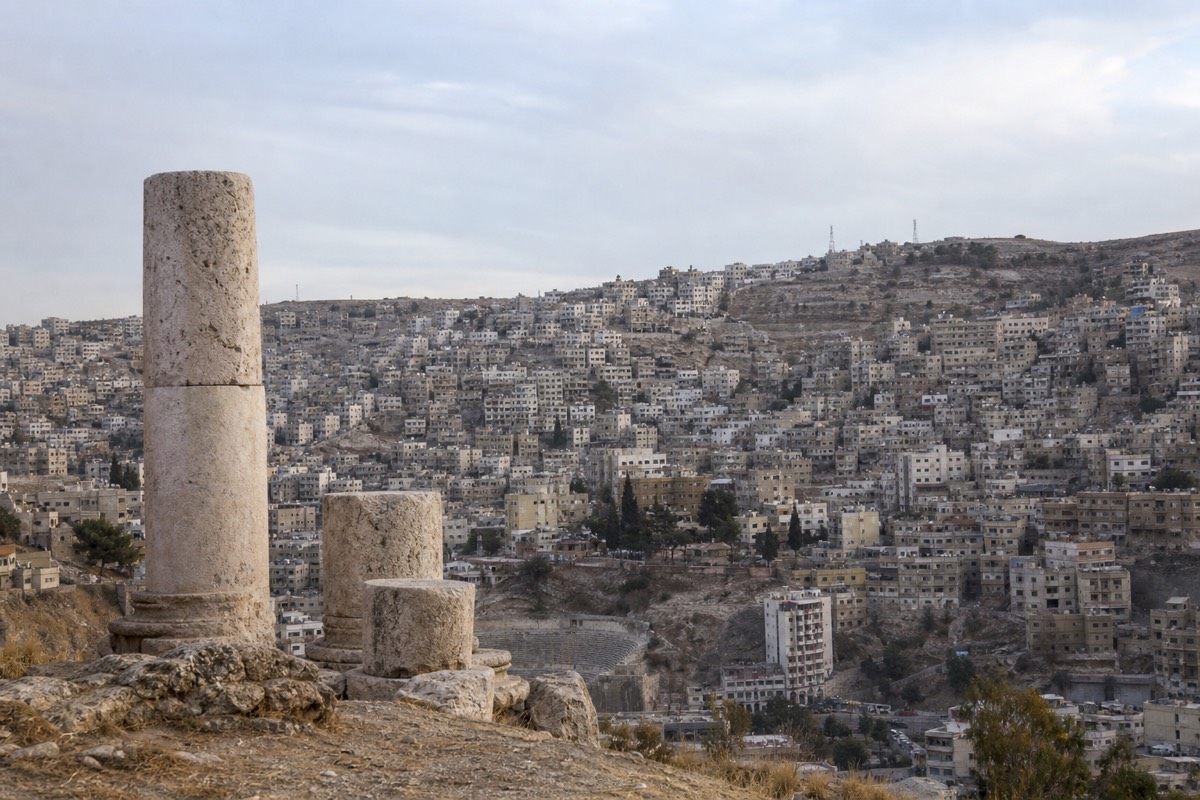
Amman does not announce itself the way Petra does. There is no single dramatic reveal, no canyon opening onto a carved facade. What it has instead is layers: a Roman theatre still standing in the middle of a modern downtown, a citadel with three thousand years of ruins stacked on one hill, and a street of cafes that would not look out of place in a European capital, all inside a twenty-minute taxi ride of each other. Here is how to actually use a day or two here before heading south.
What is Amman, and why do most Jordan trips start here?
Amman is Jordan's capital and largest city, home to more than three million people across its metro area, roughly a quarter of the country's entire population, and it is the near-universal starting point for a Jordan trip since Queen Alia International Airport, the country's main international gateway, sits just south of the city.
The city itself sprawls across a set of hills, historically referred to by number, Jabal Amman among them, and its skyline mixes glass office towers with centuries-old stone terraces in a way the official Jordan tourism board fairly describes as "a fascinating city of contrasts." Almost every guided tour to Petra, Wadi Rum or the Dead Sea begins with a pickup somewhere in Amman, which makes the city the logistical hub for the whole country even for visitors who never plan to spend time in it.
What are the best things to see in Amman in a single day?
A single focused day covers the Citadel, the Roman Theatre, a walk through downtown Amman (locally called Al-Balad), and an evening on Rainbow Street, four stops that sit close enough together to manage without a car and that between them cover Amman's Roman, Byzantine, Umayyad and modern layers.
Start at the Citadel in the morning while the light and the temperature are both manageable, walk or taxi down into Al-Balad for lunch among the souqs, then cross to the Roman Theatre in the early afternoon before it closes. Save Rainbow Street for the evening, when the cafes and galleries are actually at their best.
| Stop | Best time | Why |
|---|---|---|
| The Citadel | Morning | Cooler, best light for photos over the city |
| Downtown (Al-Balad) | Midday | Souqs, street food, the old commercial core |
| The Roman Theatre | Early afternoon | Close to Al-Balad, before closing time |
| Rainbow Street | Evening | Cafes, restaurants and galleries come alive after dark |
What is the Amman Citadel, and what will you actually see there?
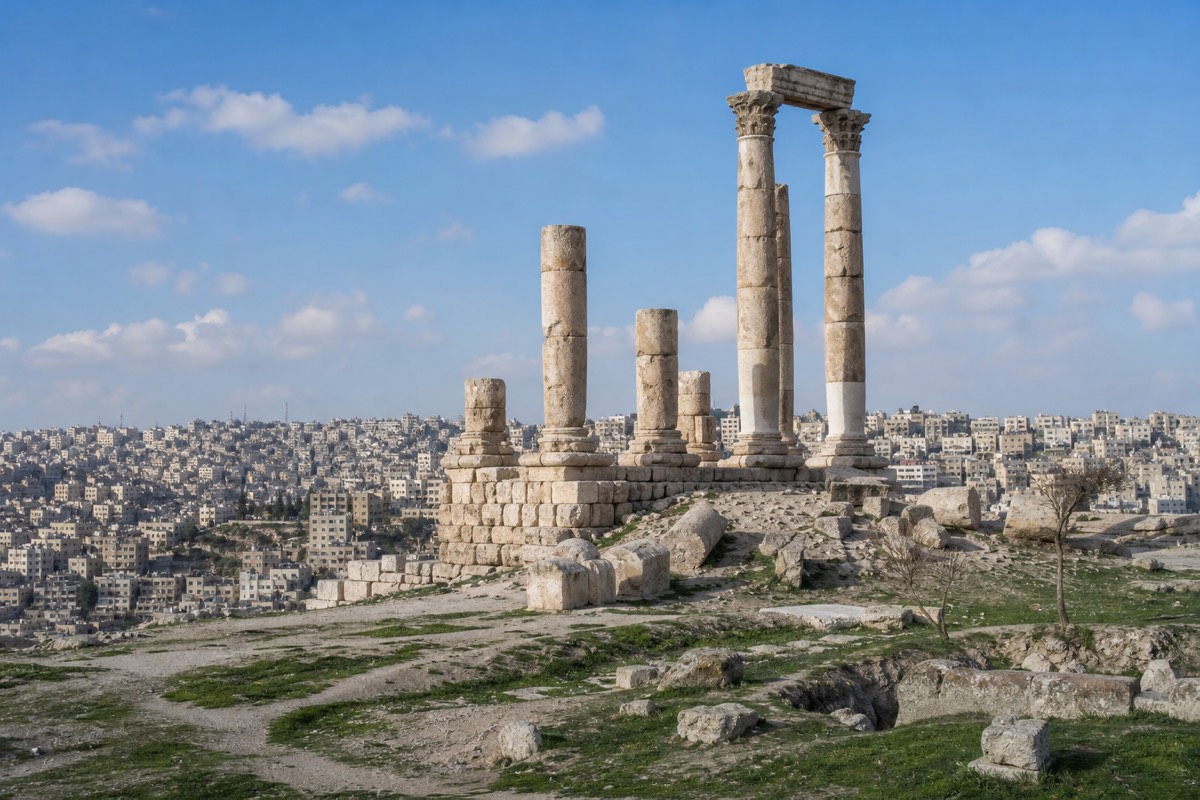
The Citadel, known locally as Jabal al-Qal'a, sits on Amman's highest hill and holds more than three thousand years of layered history, including the Roman-era Temple of Hercules, the 8th-century Umayyad Palace complex, and the ruins of a Byzantine church, all visible on foot within one hilltop site.
The Temple of Hercules is the most photographed piece, a handful of towering columns that once framed a temple so large that only a fragment of its original scale survives. The Umayyad Palace, built centuries later on the same hill, shows how the site kept getting reused by whoever controlled the city next, Roman, Byzantine, then Umayyad rulers all building on top of one another rather than starting fresh elsewhere. A modest entrance fee applies, and it is included if you are travelling with the Jordan Pass.
| Citadel highlight | Era |
|---|---|
| Temple of Hercules | Roman, 2nd century AD |
| Umayyad Palace complex | Umayyad, 8th century AD |
| Byzantine church ruins | Byzantine period |
| Jordan Archaeological Museum | On-site, houses finds from across Jordan |
What is the Roman Theatre, and can you still go inside?
The Roman Theatre is a restored, 2nd-century AD amphitheatre cut into a hillside in the heart of downtown Amman, seating around six thousand people, and it is fully open to visitors, who can walk right up onto the stone tiers. A smaller adjoining venue, the Odeon, seats up to five hundred and still hosts concerts today.
Climbing to the top row is worth the legwork for the view alone, looking back down over the stage toward the modern city rising behind it. Performances are still staged here on occasion, which is a genuinely different way to experience a two-thousand-year-old venue than simply walking through it in daylight, the same idea behind Jerash's own working theatre, if you are extending your trip north to Jerash's Roman ruins as well.
What is Rainbow Street, and when should you go?
Rainbow Street is one of Amman's oldest streets, now lined with cafes, restaurants, small art galleries and boutique shops, and it is best visited in the evening, when the street genuinely comes alive with locals and travellers rather than sitting half-empty in the midday heat.
It runs through Jabal Amman, close enough to downtown to combine with a Citadel and Roman Theatre day, and it works equally well as a low-key first evening after a long flight or a proper night out before an early Petra departure. Expect a mix of specialty coffee shops, shisha lounges and Levantine restaurants rather than a single defining venue, which is part of the appeal: it rewards wandering rather than following a checklist.
What should you eat in Amman?
Mansaf, lamb cooked in a fermented dried-yogurt sauce called jameed and served over rice, is Jordan's national dish and worth seeking out at least once, while downtown Al-Balad holds two genuine institutions: Hashem, serving falafel and hummus since 1952, and Habibah Sweets, making knafeh since 1951.
Neither of those two places is fancy, and that is the point: they are working-class Amman food landmarks that locals still queue at, not tourist recreations of them. Knafeh, a shredded pastry layered over soft cheese and soaked in sugar syrup, is the dessert to try warm and fresh rather than pre-packaged, and Al-Balad in the late afternoon, after the midday heat breaks, is the right time and place for both.
| Dish | What it is |
|---|---|
| Mansaf | Lamb in a fermented yogurt sauce (jameed) over rice, Jordan's national dish |
| Falafel and hummus | Downtown Amman staple, best fresh from a busy stall |
| Knafeh | Warm cheese pastry soaked in syrup, topped with crushed pistachio |
How do you get around Amman?
Central Amman, the Citadel, downtown, Rainbow Street, is walkable in short stretches but spread across enough hills that most visitors mix walking with taxis or a ride-hailing app for the longer connections. Metered taxis and ride apps are cheap, plentiful and the standard way to move around the city outside the historic core.
Public buses exist but are aimed at local commuters rather than visitors and are not the practical choice on a short trip. If you are staying in Jabal Amman or Abdoun, expect a short taxi ride to reach downtown and the Citadel rather than a walk, since Amman's hills make distances feel longer on foot than they look on a map.
Where should you stay in Amman before a Petra tour?
Jabal Amman and downtown Al-Balad suit first-time visitors who want walking access to the Citadel, the Roman Theatre and Rainbow Street, while Abdoun and Shmeisani suit travellers who prioritise modern hotels, restaurants and an easier taxi run to the airport the next morning.
Jabal Amman leans bohemian and historic, with a genuine concentration of Amman's best cafes and restaurants within walking distance. Abdoun is more upscale and quieter, popular for its own restaurant and nightlife scene. Shmeisani is the most modern district, closer to business hotels than boutique guesthouses, a practical choice if convenience matters more than atmosphere. Downtown Al-Balad puts you inside the souqs themselves, the cheapest and most atmospheric option but also the busiest and least polished.
| Area | Best for |
|---|---|
| Jabal Amman | First-timers, walkable history, cafes and nightlife |
| Downtown (Al-Balad) | Budget stays, souqs, the most atmospheric option |
| Abdoun | Upscale restaurants and bars, a quieter base |
| Shmeisani | Modern business hotels, easy airport access |
Is Amman safe to visit right now?
Amman's tourist areas, the Citadel, downtown, Rainbow Street and the neighbourhoods around them, are generally calm and heavily used by both locals and visitors day to day. That said, official guidance for Jordan as a whole has carried a heightened advisory through 2026 given wider regional tensions, so it is worth checking current guidance before you travel rather than relying on an older assumption either way.
The US State Department's Jordan travel advisory has listed the country at a heightened risk level through 2026 amid regional instability, while specifically noting that central Amman and its main tourist districts sit among the lower-risk areas within that advisory. Practical common sense covers most of it: stick to central, well-travelled areas, use metered taxis or a ride-hailing app rather than unmarked cars, avoid demonstrations and areas near the Syrian and Iraqi borders, and keep your travel plans flexible, since regional developments have occasionally caused short-notice flight disruptions. None of that is unique to Jordan among destinations in the wider region, and it is the same baseline caution worth applying to Jordan's safety picture more broadly, which we cover in more depth separately.
What is Amman's nightlife actually like?
Amman's nightlife centres on Rainbow Street and Abdoun, both known for a genuine mix of rooftop bars, shisha lounges, live music venues and late-dinner restaurant culture, closer in spirit to Beirut or Istanbul than to a conservative Gulf capital, though it is still a Muslim-majority city and dress and behaviour norms lean more modest than in a typical Western nightlife district.
Weekend nights, Thursday and Friday locally, are noticeably livelier than weekday evenings. Alcohol is available at licensed restaurants, bars and hotels, though it is not sold everywhere, and a respectful, low-key approach goes further here than it would in a city built entirely around tourism. If a big night out matters to your trip, Abdoun's bar and restaurant density is the more reliable bet over Rainbow Street's more cafe-and-gallery-leaning scene.
How do you fly into Amman, and are there direct flights?
Queen Alia International Airport (AMM), just south of the city, is Jordan's main international gateway and the hub for Royal Jordanian, the national carrier, which flies direct to more than 60 destinations including New York, Chicago, Dallas and Montreal in North America and a wide spread of European capitals such as London and Brussels.
Depending on where you are travelling from, a direct Royal Jordanian route or a one-stop connection through a major European or Gulf hub are both common ways in. Airport transfers into central Amman typically run 30 to 45 minutes by taxi or a pre-booked driver, and most guided multi-day tours build their first pickup around whichever flight schedule you give them, so it is worth sharing your arrival details early when you book.
| Route type | Example destinations |
|---|---|
| Direct, North America | New York, Chicago, Dallas, Montreal |
| Direct, Europe | London, Brussels, and other major capitals |
| Regional / connecting | Extensive Gulf and Middle East network via Amman's hub |
Does Amman's weather differ from Petra and the Dead Sea?
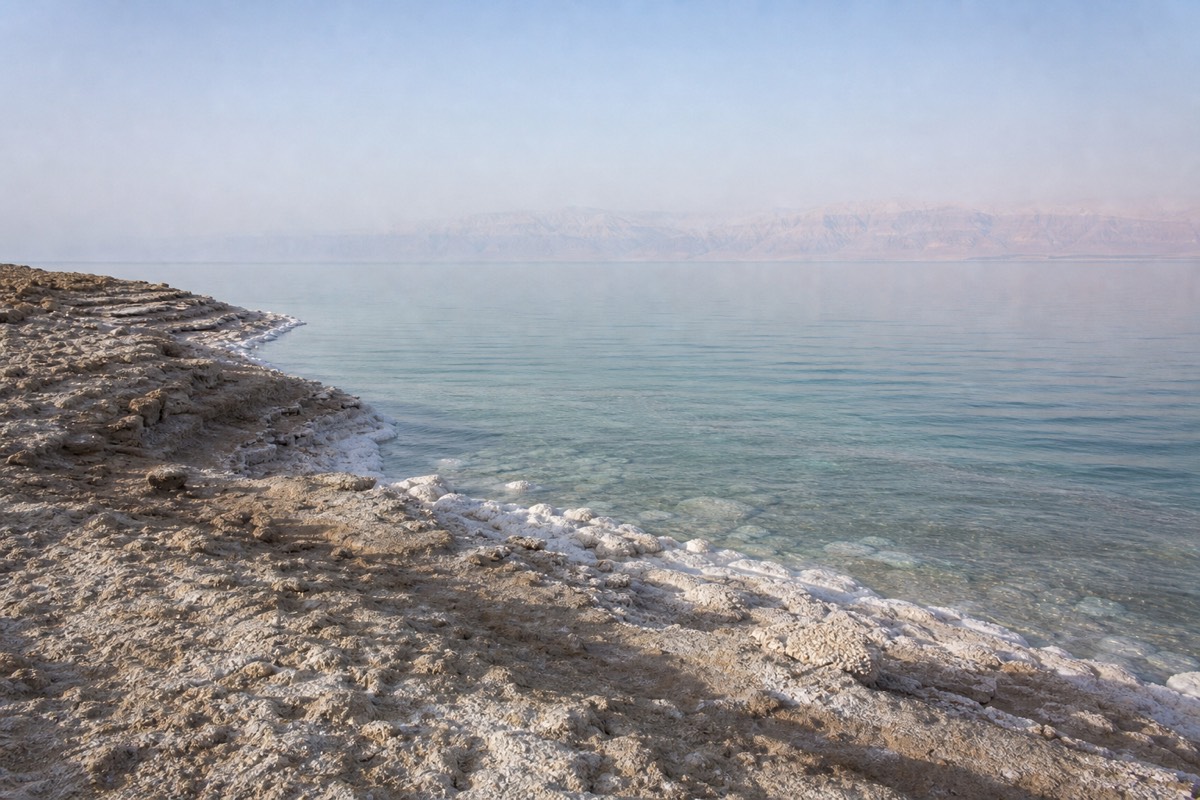
Yes, noticeably. Amman sits at roughly 800 metres above sea level, which keeps it several degrees cooler than Petra and considerably cooler than the Dead Sea, the lowest point on Earth's land surface, where summer heat regularly climbs past 40 degrees Celsius while Amman stays closer to the low 30s.
That gap matters for packing: a jacket that feels unnecessary in Amman on a summer evening becomes genuinely useful again after dark, since the city's elevation gives it cooler mornings and evenings year-round compared with the desert legs of a trip. Winter flips part of that pattern, with Amman and Petra both running cooler than the Dead Sea and Aqaba, which stay noticeably milder thanks to their low elevation.
| Location | Typical summer high | Typical winter day |
|---|---|---|
| Amman (~800 m elevation) | Low-to-mid 30s °C | 8 to 15°C |
| Petra | Mid 30s °C | 8 to 15°C |
| Dead Sea (below sea level) | 40°C+ | 18 to 22°C |
How much time should you spend in Amman before heading to Petra?
One full day covers the highlights comfortably: the Citadel, the Roman Theatre, downtown and an evening on Rainbow Street. Two days gives room to add Jerash as a half-day trip north, or simply to slow down and treat Amman as a destination rather than a stopover before the drive south.
Most of our multi-day tours, including the 4-day Jerash, Petra, Wadi Rum and Dead Sea tour and the 3-day Jordan highlights tour, already build a morning in Amman into the first day before heading out, so you are not necessarily choosing between Amman and the rest of the country: a well-built itinerary gives you both without adding extra nights. If your trip is tighter, even a half day squeezed in before an early Petra departure is enough to see the Citadel and grab a proper Jordanian breakfast in Al-Balad first.
| Time available | What to prioritise |
|---|---|
| Half day | The Citadel and a meal in downtown Al-Balad |
| Full day | Citadel, Roman Theatre, downtown, Rainbow Street evening |
| Two days | Add a half-day trip north to Jerash |
So how should you plan your time in Amman?
Give it more than a layover if your schedule allows even one extra day: the Citadel and the Roman Theatre are genuinely worth the visit on their own terms, not just as a warm-up act for Petra. Base yourself in Jabal Amman or Abdoun if you want walkable evenings, follow the common-sense safety habits above, and check your flight's route into Queen Alia early so your first pickup goes smoothly. For everything south of the city, the Treasury walk, Wadi Rum, the Dead Sea, Petra Jordan Tours lines up the operators who handle the pickup straight from your Amman hotel, so the capital is a proper first chapter of the trip rather than just the place you landed.