
Wadi Rum Bubble Tents: Sleeping Under the Stars in the Desert
Somewhere in the last decade, a handful of Wadi Rum camps swapped their canvas roofs for clear plastic domes, and the photos did the rest of the marketing. Here is what a bubble tent actually is, what it is like to sleep in one, how it compares to a traditional Bedouin tent, and what to actually expect before you book a night in the desert.
Booking Choice: Wadi Rum Jeep And Bubble Night takes 4-hour jeep + overnight, starting in Wadi Rum. Explore This Trip
General starting recommendation. Confirm your chosen room, meeting point and next-morning return time. No Amman transfer included.
We may earn a commission when you book through these links.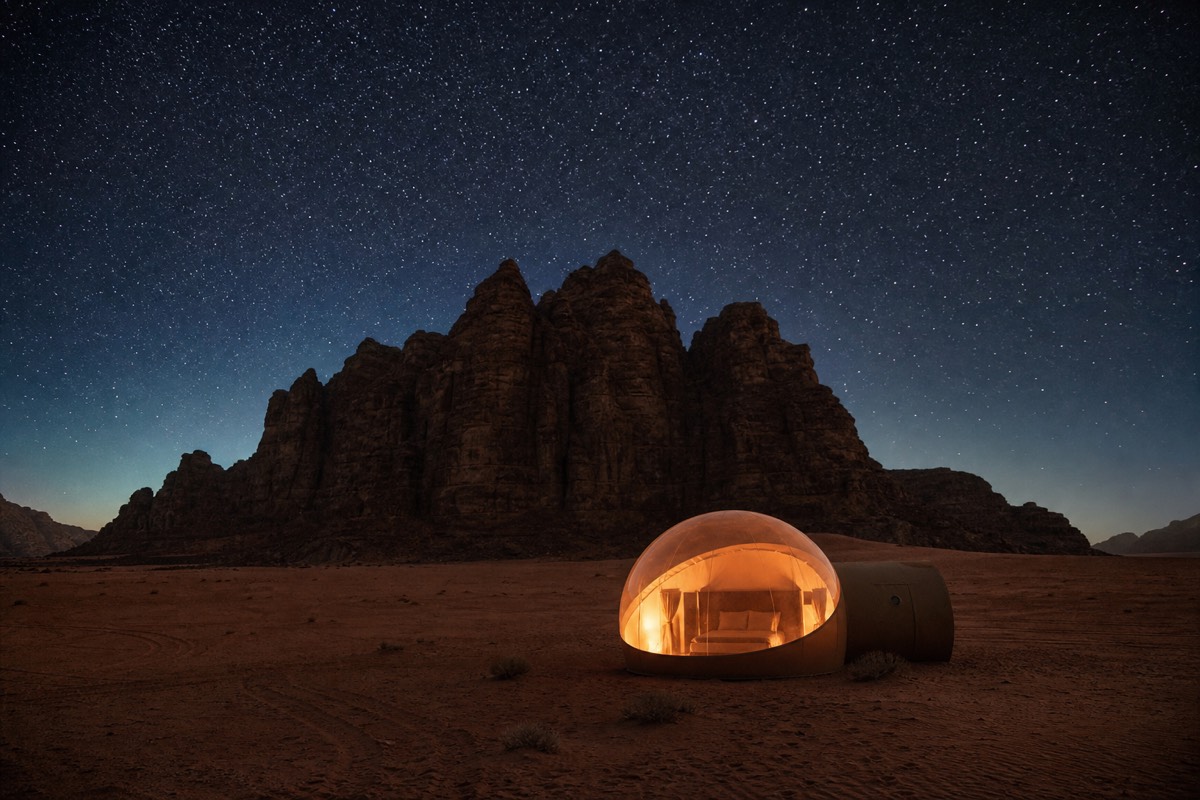
Wadi Rum has been a working desert for Bedouin communities for generations, long before anyone thought to put a transparent dome over a bed. The bubble tent is a newer addition, built specifically around one thing the traditional tent was never designed to offer: an unobstructed view of the sky from a warm bed, with nothing between you and the stars but glass. What follows covers what these structures actually are, what a night in one is really like, and how they stack up against the traditional camp experience they sit alongside rather than replace.
What is a Wadi Rum bubble tent, exactly?
A Wadi Rum bubble tent is a small, semi-permanent structure with a transparent dome or panel roof, usually set on a solid platform, built specifically so guests can see the desert sky from bed. Most are marketed under names like "bubble tent," "Martian dome" or "full of stars," and they typically include a real bed, private bathroom, and basic climate control rather than the sleeping mats of a traditional camp.
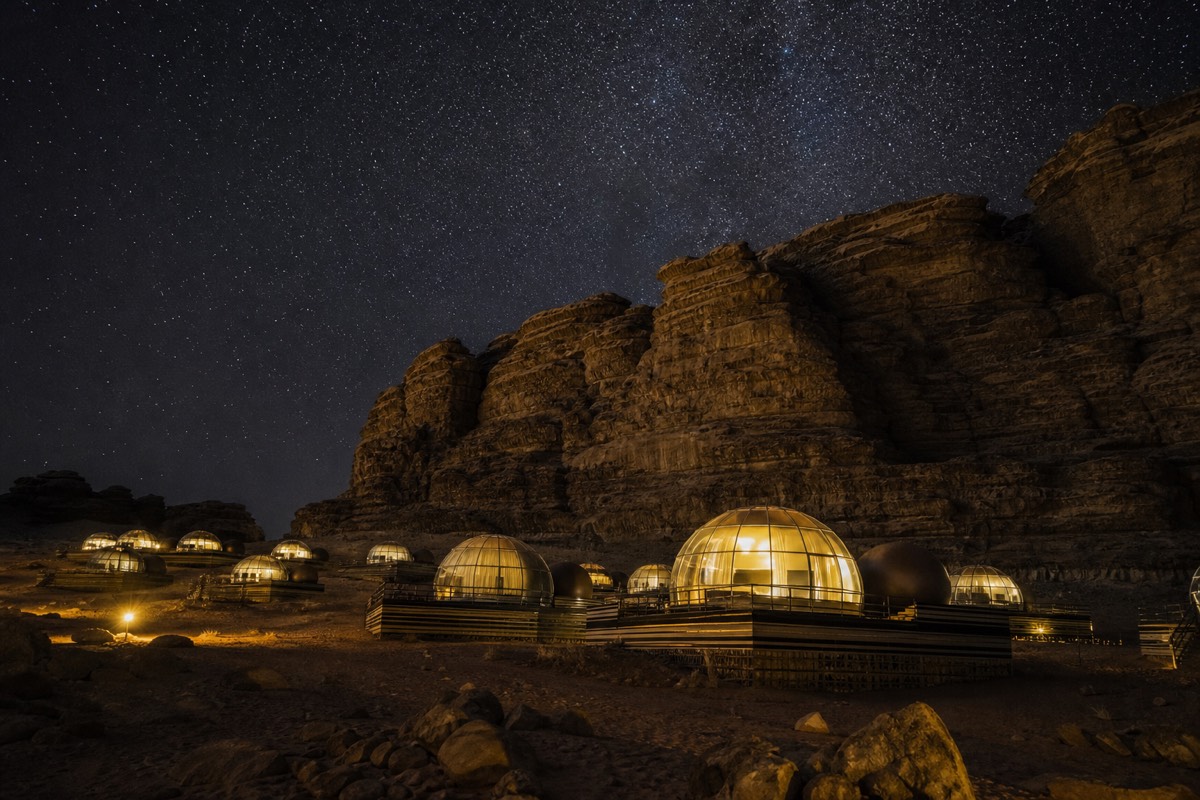
Despite the name, "tent" undersells the structure. Most bubble accommodations are closer to a small glass-fronted cabin than fabric shelter, built to withstand desert wind and temperature swings while keeping the transparent panels clear. The best-known clusters sit in the Wadi Rum Protected Area, a landscape recognized as a UNESCO World Heritage site for both its natural rock formations and its long human history, including its association with T.E. Lawrence during the Arab Revolt.
The idea did not originate in Jordan. Clear-domed glamping has spread across several desert and remote destinations over the past decade, but Wadi Rum's version leans hard into a specific pitch: sleep somewhere that looks like the surface of another planet, in a room built to make that view the whole point. Given how often the valley has doubled as an actual alien or Martian landscape on film, the marketing angle is not exactly a stretch.
Where are the bubble camps, and how do you book one?
Bubble camps sit scattered through the Wadi Rum Protected Area, usually run by local Bedouin-owned operators alongside their traditional camps rather than as standalone properties. Most travelers book a bubble night as part of a multi-day tour package rather than reserving a bubble unit directly, since the camps typically work through tour operators for logistics like the jeep transfer in and out.
This matters practically: Wadi Rum's interior is not somewhere you drive yourself to easily, and most camps, bubble or traditional, are reached by 4x4 rather than a regular car. Booking through a packaged tour, like our own two-day and three-day routes, folds that transfer into the price rather than leaving you to arrange it separately.
| Booking route | How it works |
|---|---|
| Packaged multi-day tour | Bubble night, jeep transfer and daytime sightseeing bundled together |
| Direct camp booking | Possible with some operators, transport usually arranged separately |
| Walk-in | Not realistic, camps sit inside a protected desert area reached by 4x4 |
| Quick facts | Bubble tent |
|---|---|
| Roof | Clear dome or panel, usually geodesic |
| Structure | Semi-permanent, on a raised platform |
| Typical bathroom | Private, en-suite |
| Typical climate control | Air conditioning or heating |
| Best feature | Full sky view from bed, no need to step outside |
Why sleep in a bubble tent instead of a regular Bedouin tent?
The single reason is the view: a bubble tent lets you watch the stars, and often the sunrise, from a comfortable bed without leaving the room, something a traditional canvas tent's solid roof cannot offer. Traditional Bedouin camps trade that view for a more communal, culturally grounded evening, usually built around a shared fire, a group dinner and simpler sleeping arrangements.
Neither is a better desert experience in the abstract, they are just built around different priorities. A bubble tent suits travelers who want the stargazing to be effortless and private. A traditional tent suits travelers who want the evening itself, the fire, the food, the conversation, to be the centerpiece, with sleep almost an afterthought.
Couples celebrating something specific, an anniversary, a honeymoon, tend to lean toward the bubble option for exactly this reason: it turns an ordinary night into the memorable part of the trip rather than a stop along the way to it. Groups and families more often gravitate to the traditional camp, where a shared fire and a communal dinner suit a bigger party better than a room built for two.
| Bubble tent | Traditional Bedouin tent | |
|---|---|---|
| Sky view | Unobstructed, from bed | Only outside the tent |
| Privacy | Usually en-suite bathroom | Often shared facilities |
| Atmosphere | Quieter, more private | More communal, fire-centered |
| Feel | Modern, novel | Traditional, cultural |
| Availability | Limited units per camp | Widely available across camps |
What's it actually like inside?
Most bubble tents pair the transparent roof with amenities closer to a small hotel room than a camping setup: a real bed rather than a mat, a private bathroom with a shower, some form of air conditioning or heating, and basic furniture like a couple of chairs and a small storage area.
The specific inclusions vary a lot by camp and by tour operator, so treat any list as a general pattern rather than a guarantee for a specific booking. What is fairly consistent across most bubble setups is the core promise: a real bed, a clear roof, and enough climate control to make sleeping under glass comfortable rather than an ordeal.
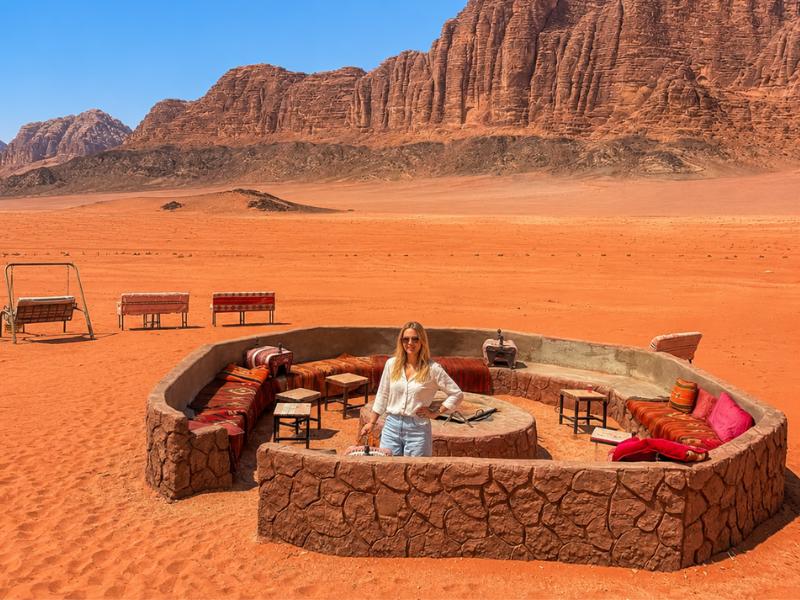
A meal is usually part of the package too, typically a traditional dinner and breakfast served at a shared camp area rather than inside the individual bubble unit, since the domes themselves are built for sleeping and viewing rather than dining. That shared-meal structure is one place where the bubble and traditional experiences overlap: you generally still eat together, around a fire, even if you retreat to a glass room afterward instead of a canvas one.
| Commonly included | Notes |
|---|---|
| Real bed (not a floor mat) | Standard across most bubble units |
| Private bathroom | Usually attached, varies by camp |
| Air conditioning or heating | Important given desert temperature swings |
| Seating area | Small chairs or a bench, varies by unit |
| Electricity | Typically available, confirm for remote camps |
Is it too hot or too cold to sleep under a glass dome?
Not if the camp has working climate control, which most established bubble camps do. Desert nights swing hard, warm days can drop to genuinely cold nights even in the warmer months, and a transparent roof with no insulating layer would make that swing worse without a working AC or heating unit, which is exactly why reputable camps build it in.
This is the detail worth confirming before you book rather than after you arrive: not every operator's climate control is equally reliable, and a bubble tent without working temperature management on a cold desert night is a genuinely uncomfortable place to be. It is a fair question to ask when checking a listing, especially for a stay outside the peak spring and autumn months.
What's the difference between the bubble-camp tour and the standard Bedouin-camp tour?
Our two-day Petra, Wadi Rum and Dead Sea options split on exactly this point: one overnights in a standard Bedouin camp, the other in a Wadi Rum bubble room, while covering essentially the same route through Petra, a Wadi Rum jeep safari and the Dead Sea. The bubble version costs more for the upgraded room; check the current listing price for both, since the bubble tour's rate is not fixed and worth comparing at booking time.
Everything else about the two trips runs on a similar structure: an early transition to Petra for sightseeing, an afternoon jeep safari through the red sand of Wadi Rum, a desert dinner, and a Dead Sea stop before returning to Amman. The choice mostly comes down to how much the sleeping arrangement itself matters to you, since the daytime itinerary does not change much between the two.
Both tours run to a similar rhythm: pickup from Amman, several hours at Petra to walk the Siq and see the Treasury, a transfer into Wadi Rum for the jeep safari through the sand and rock formations, then dinner and the night at camp before a second day that takes in the Dead Sea before heading back. The version with the bubble room simply swaps what you do between dinner and breakfast; the surrounding day is built the same way on both.
| Standard 2-day tour | Bubble-camp 2-day tour | |
|---|---|---|
| Overnight stay | Traditional Bedouin camp | Luxury bubble room |
| Petra visit | Included | Included |
| Wadi Rum jeep safari | 2-hour 4x4 safari | 2-hour 4x4 safari |
| Dead Sea stop | Included | Included |
Do you get real privacy in a bubble tent?
Most bubble accommodations are built as single, self-contained units spaced apart from each other, which gives you more privacy than a shared traditional tent, but the transparent walls mean privacy from the outside world (the desert, the sky) works differently than privacy from other guests. Curtains or opaque panels for daytime or for modesty are common but vary by camp.
If privacy from other campers matters most to you, a bubble tent generally delivers it well, since most camps do not pack units close together. If what you are picturing is a fully private, closed-off room at all times, ask the specific camp about curtain or shade options, since the whole design intentionally works against total enclosure.
Is it safe, and are there any real downsides?
Wadi Rum's camps, bubble or traditional, operate as an established part of the region's tourism economy, and the desert itself is not a place where insects or wildlife pose a meaningful risk beyond the usual desert-camping basics. The more practical downsides are the ones already covered: variable climate control, limited privacy through the glass, and glare that works against serious astrophotography.
The other honest downside is exclusivity. Bubble units are a small slice of any camp's total capacity, often just a handful per site, so they book out faster than standard tents, especially around the busy spring and autumn seasons. If a bubble night is central to your plans, book it earlier than you would a standard camp stay, and confirm the specific unit rather than assuming any camp advertising "bubble tents" has one free on your dates.
Water use is another small practical detail worth knowing. Remote desert camps generally run on trucked-in or limited water supplies, so showers tend to be shorter and simpler than a hotel's, bubble tent or not. It is a minor adjustment for most travelers, but one worth expecting rather than discovering at 11 PM in the middle of the desert, when the nearest alternative is nothing but sand in every direction.
When is the best time of year for stargazing in a bubble tent?
Spring (March to May) and autumn (September to October) offer the best balance of clear skies and comfortable night temperatures, the same shoulder-season window that works best for Petra itself. Summer nights are warmer and more comfortable for stargazing but daytime jeep tours run hot; winter nights can be genuinely cold, testing whatever heating the bubble tent has.
New moon periods anywhere in that window give the darkest, clearest skies, since Wadi Rum's isolation already keeps light pollution low most nights. If stargazing is the main reason you are booking a bubble night at all, checking the moon phase for your travel dates is worth five minutes before you commit to a booking.
Cloud cover is rarely the problem it would be at a coastal or mountain destination. Wadi Rum sits in one of the driest parts of a dry country, so clear nights are closer to the norm than the exception across most of the year, which is part of why the region became a stargazing draw in the first place, long before anyone built a dome to watch it from.
| Season | Night sky | Comfort |
|---|---|---|
| Spring (Mar-May) | Clear, good visibility | Comfortable |
| Summer (Jun-Aug) | Clear, warm nights | Hot by day, mild at night |
| Autumn (Sep-Oct) | Clear, good visibility | Comfortable |
| Winter (Nov-Feb) | Often very clear, less haze | Cold, test the heating |
What should you pack for a night in a bubble tent?
Pack for a genuinely remote overnight: a warm layer for after sunset, any personal toiletries you cannot count on the camp stocking, a power bank in case charging is limited, and a headlamp or phone flashlight for moving around camp after dark. None of this is unique to a bubble tent, but the isolation of Wadi Rum makes it matter more than it would at a hotel.
Camps are usually a reasonable drive from the nearest town, so anything you forget stays forgotten for the night. Bring earplugs if you are a light sleeper too; a transparent roof does nothing to dampen wind noise, and a gusty desert night can be louder than the silence you were picturing.
| Pack | Why |
|---|---|
| Warm layer or light jacket | Desert nights cool fast, even after a hot day |
| Power bank | Charging can be limited at remote camps |
| Headlamp or phone flashlight | Moving around camp after dark |
| Earplugs | Wind noise carries against a glass roof |
| Personal toiletries | Do not assume the camp stocks your preferred brand |
Is a bubble tent actually good for night-sky photography?
It is good for comfortable viewing, but genuine astrophotography usually works better outside the dome than through it, since curved plastic panels tend to introduce glare and reflections that a flat, open sky does not. Most bubble camps sit in genuinely dark locations, so stepping outside for ten minutes with a tripod is worth it if photos are the priority.
Use the dome for what it is best at: watching the sky shift while you are warm and half-asleep, not for a serious long-exposure shoot. If a specific photo matters to you, most camps allow guests to set up just outside their unit, which gets you the same dark sky without shooting through glass.
Is a bubble tent worth the upgrade over a standard tent?
For anyone who genuinely wants the stargazing-from-bed experience, or who is celebrating something specific on the trip, yes, it is a worthwhile upgrade. For travelers who care more about the shared campfire, Bedouin hospitality and traditional dinner atmosphere than the view from their pillow, the standard tent delivers that side of the experience just as well, at a lower cost.
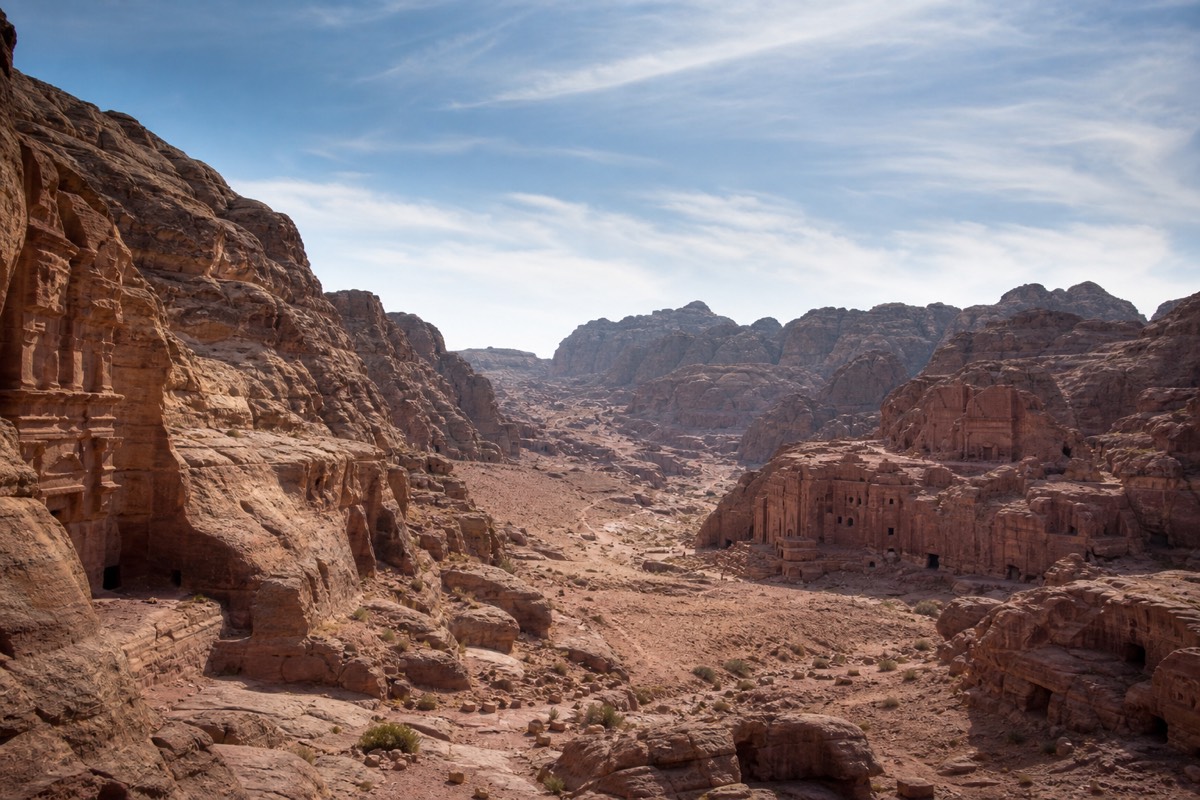
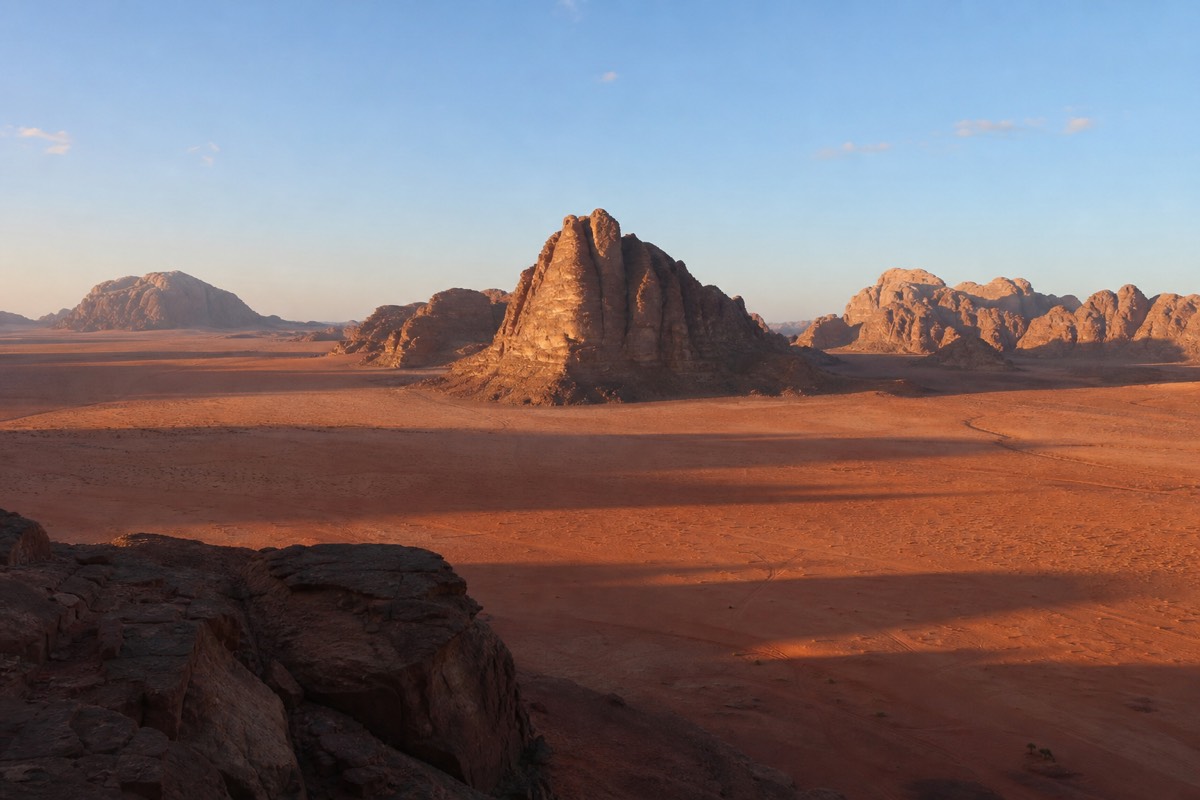
Neither choice is a mistake. Wadi Rum's daytime experience, the jeep safari across the red sand and towering rock formations, is identical either way. The overnight is the only real variable, and it is worth choosing deliberately rather than defaulting to whichever option is cheaper or more heavily marketed in search results.
So which one should you book?
Pick the bubble tent if the photo of you lying in bed under a dome of stars is genuinely part of why you are coming to Wadi Rum, and pick the traditional tent if the fire, the food and the shared evening matter more to you than the ceiling. Either way, the daytime jeep safari across the same red sand comes with it, so the wrong choice here is smaller than it feels while you are deciding. The simplest way to lock in either option without chasing separate bookings is to let a guided route handle it, and Petra Jordan Tours lines up the operators who run both versions of the trip, so the only decision left is which roof you want over your head.